








Press Release
Meeting with the British American Security Information Council (BASIC), UK
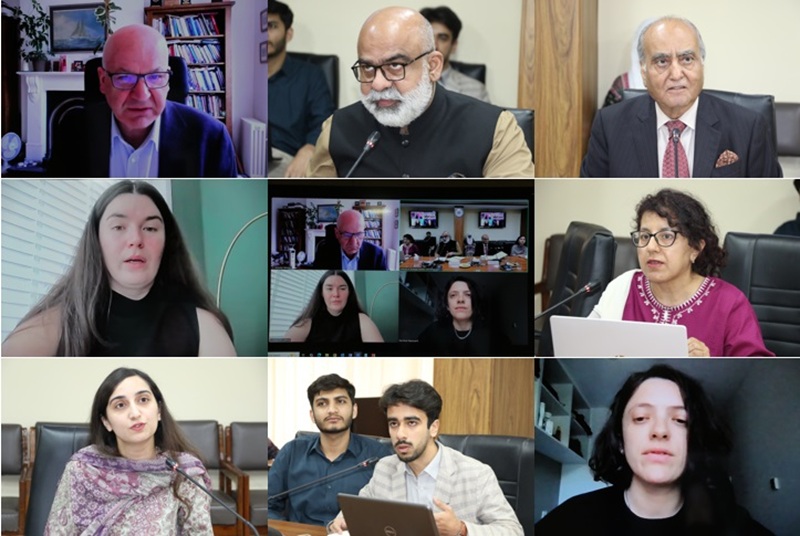
The Arms Control and Disarmament Centre (ACDC) at the Institute of Strategic Studies Islamabad (ISSI) held an online meeting with the British American Security Information Council (BASIC), UK, to discuss the implications of Emerging and Disruptive Technologies (EDTs) on South Asian Strategic Stability and Nuclear Escalation Risks, and De-escalation Pathways.
In his opening remarks, Ambassador Khalid Mahmood, Chairman Board of Governors ISSI, highlighted that the international and regional security environment is undergoing a profound change driven by emerging technologies like AI, cyber capabilities, drones, and hypersonic weapons. These can have serious implications for South Asia. He noted that these technologies compress decision-making time and blur the lines between conventional and nuclear deterrence. He emphasized that for Pakistan, maintaining strategic stability requires bringing emerging technologies under the ambit of international law and practicing mutual restraint to prevent unintended escalation.
Malik Qasim Mustafa, Director ACDC, said that the May 2025 crisis indicates that in the evolving “uncertain” future security environment, states have to learn to live with dual-use emerging technologies by understanding them, developing them, and utilizing them in all domains to ensure peace, security, and stability. Pakistan needs to modernize its military capabilities, including its means of delivery, to deter any future attack and aggression. He also emphasized the need to work on bilateral confidence-building measures to reduce the threat of misunderstanding and unintentional escalation.
Representing BASIC, Professor Nicholas J. Wheeler, Ms. Eva-Nour Repussard, and Ms. Mhairi McClafertty shared the key findings of their research. They noted that the rapid integration of EDTs creates new vulnerabilities in existing Confidence-Building Measures (CBMs) and argued for a “responsibility-based approach” to technology governance to reduce nuclear risks. Ms. Eva-Nour Repussard highlighted that technologies like AI-driven cyber operations, hypersonic missiles, and autonomous weapons significantly shorten decision-making timelines. This “maturity perception effect” suggests that as these technologies become more integrated, they increase the risk of unintended escalation. A key finding was that current CBMs are inadequate. There is a notable gap in how risks are perceived. Pakistan’s concerns are heightened by the perceived strategic alignment and technology transfers between the U.S. and India, which Islamabad views as destabilizing the regional security environment. It was argued that “responsible practices” and regional dialogues on AI safety and cyber norms are needed to prevent future crises from sliding into full-spectrum conflict. Ms. Mhairi McClafertty talked about the perception of escalation dominance and emphasized that psychological perceptions are instrumental in escalation and de-escalation. Misperceptions can drive escalation. Each side considered their own actions as non-threatening and the other side’s as threatening. They drew valuable lessons for future conflict de-escalation.
Mr. Wheeler talked about “escalation cascades” driven by domestic pressure, psychological factors, and inaccurate signaling. He concluded that both sides needed to work together to de-escalate. Recommendations by Mr. Wheeler included – high-level hotlines, including establishing direct communication between Prime Ministers and National Security Advisers; enhancing existing DGMO channels to manage crises cooperatively. He said that crisis management should not be considered as Zero sum, but a win-win for both sides.
The meeting was followed by an interactive discussion where participants agreed that sustained dialogue between regional and international stakeholders and 1.5 and track 2 engagements is essential to navigate the uncertainties of the digital age and to build robust frameworks for crisis management. Emphasis was given to managing crises by cooperation rather than coercive diplomacy and reducing reliance on third-party intervention.