






Remarks by Ambassador Sohail Mahmood, Director General, Institute of Strategic Studies Islamabad (ISSI), at Seminar: “The Bandung Spirit (1955–2025): Seven Decades of Solidarity, Sovereignty, and South-South Cooperation”, ISSI
30 April 2025
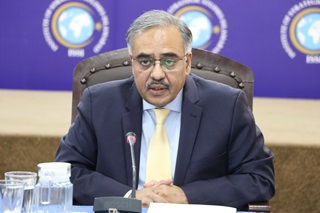
I wish to begin by extending a warm welcome to everyone to this ISSI seminar, commemorating a major milestone in our shared history — the 70th Anniversary of the Bandung Conference. This occasion has special salience for Pakistan as it was one of the 5 organizing states of the Conference. Prime Minister Mohammad Ali Bogra represented Pakistan and contributed significantly to its successful outcome.
We are privileged to have eminent academics, practitioners, and thought leaders as part of our panel today. Their views and perspectives on various dimensions of our theme would immensely enrich the proceedings. I am particularly grateful to Senator Mushahid Hussain Sayed for joining us as chief guest. His ability to analyze historical trends and project the future trajectory of global politics is as remarkable as it is instructive. I have no doubt that we would all be wiser on this subject by the time we conclude the seminar.
Distinguished participants,
Seventy years ago, in April 1955, leaders from 29 newly independent nations of Asia and Africa gathered in Bandung, Indonesia, to chart both an ambitious and visionary course in international relations. Emerging from the long shadow of colonialism, these nations wished to assert their sovereignty; work for enhanced economic and cultural collaboration; and steer away from the confining framework of bloc politics at that high noon of the Cold War. Rejecting domination or division, they placed emphasis on mutual respect, equality and solidarity.
It is, however, important to remember that the Bandung Conference was preceded by the enunciation of the “5 Principles of Peaceful Coexistence” on 28 June 1954. China’s Premier Zhou Enlai played a seminal role in articulating these 5 Principles — which include mutual respect for sovereignty and territorial integrity; mutual non-aggression; non-interference in each other’s internal affairs; equality and mutual benefit; and peaceful coexistence. These 5 Principles represented Asian wisdom and the post-Revolution China’s first major contribution to global diplomatic thought.
The 10-point Declaration adopted by the Afro-Asian Conference at Bandung in 1955 fully incorporated those 5 principles. In addition, the Bandung Conference placed strong emphasis on respect for fundamental human rights, adherence to the principles and purposes of the UN Charter, rejection of the threat or use of force, settlement of disputes through peaceful means, and promotion of international cooperation.
The leaders participating in the Conference were conscious of the historic significance of their undertaking. In effect, they were putting forth an alternative, non-Western vision to what had essentially been a Western paradigm in international relations for a long time. The host President Sukarno emphasized that they were “injecting the voice of reason in world affairs.” Premier Zhou Enlai, a star participant of the Conference, presciently advised that the goal should be to find common ground, not to foster divisions.
Scholars have written extensively about the “Bandung Spirit” that emerged from the Conference and represented a common desire for: peaceful coexistence; liberation of the world from hegemony, colonialism, imperialism, and any form of domination of one country by another; equality of races and nations; solidarity with the poor and the weak; and people-centered development. The Conference also inspired the development of several new legal norms and institutions aimed at safeguarding the interests of the developing or the so-called “Third World” emerging at the time.
The Bandung Conference was indeed a defining moment as it sowed the seeds of what subsequently turned into powerful movements and historical trends – such as non-alignment; quest for a ‘New International Economic Order’; and South-South cooperation.
In a fundamental sense, the principles and values fostered by the Bandung Conference continue to have relevance in today’s world — which is marked by geopolitical flux, strategic competition, growing incidence of the use of force and armed conflicts, erosion of time-honored norms of inter-state relations, and multilateral institutions under stress. Amidst all this, the “Bandung Spirit” offers not only lessons but also inspiration to reaffirm our commitment to peaceful coexistence, resist hegemonic tendencies, and advance a just, inclusive and equitable global order.
As noted, Pakistan was as one of the founding participants at Bandung. It has remained steadfast in upholding Bandung’s principles. Over the past seven decades, Pakistan has consistently advocated for peaceful conflict resolution, mutual respect among nations, and stronger regional and global cooperation. Pakistan’s all-weather strategic cooperative partnership with China, active engagement in forums like the Shanghai Cooperation Organization (SCO), and support for initiatives like the Belt and Road Initiative (BRI) are important reflections of this unwavering commitment.
As we celebrate the legacy of Bandung, we should be mindful that there are skeptics out there questioning its relevance in today’s world. An essay in the latest issue of The Economist, for instance, highlights what it calls a “damp squib anniversary” of Bandung attributable to “lack of solidarity.” It seems to base its case on perceived lack of Afro-Asian unity, the development gap between Asia and Africa, the emergence of groupings like BRICS, and a tendency among major developing countries to chart their individual course and increase their global clout.
While these assertions might have some grain of truth, they do not represent the full picture. The so-called ‘Global South’ today is much more confident, more interconnected, and increasingly influential in shaping global discourses. Its increased agency is enabling it to play a more pivotal role in the transforming global order. Still, there is also no denying the fact that the path ahead requires continued solidarity, mutual support, and collective resolve to address challenges ranging from poverty and inequality to climate change and technological divides.
As we reflect on this remarkable journey of the past seventy years, it is important to seek practical ways to further strengthen the bonds among the nations of the ‘Global South’, promote peace and development, and contribute to a fairer and more harmonious world.
Once again, I thank all the eminent speakers and participants for joining us for this important commemoration. I am confident that today’s deliberations will be rich, insightful, and forward-looking.
Thank you.