




Remarks by DG ISSI Ambassador Sohail Mahmood at Inaugural Session of Islamabad Conclave: “Re-imagining South Asia: Security, Economy, Climate, Connectivity”, ISSI, 3 December 2025
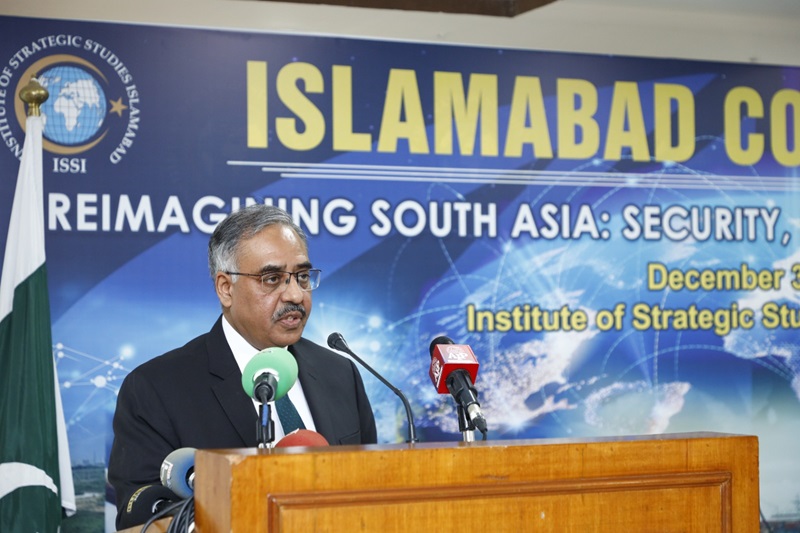
It is a distinct privilege to welcome everyone to the Institute of Strategic Studies for the 5th Edition of Islamabad Conclave, our annual flagship event held every December. This edition is particularly special as we have both in-person and on-line participation of eminent speakers from several South Asian nations.
We are honoured to have Honourable Senator Mohammad Ishaq Dar, Deputy Prime Minister and Foreign Minister of Pakistan, as the Chief Guest. Given his vast experience in public life spanning over more than four decades, and his pivotal position in the policy space, our participants stand to benefit hugely from his valuable views and perspectives. As a matter of fact, this year’s theme of “re-imagining” South Asia is inspired by what the DPM stated during his address at the ISSI Foundation Day event in June 2025. I thank you, Sir, for gracing this occasion and for being a constant source of support and encouragement as the Patron of the Institute.
We also warmly welcome all the esteemed speakers, from Pakistan and abroad, and look forward to their enlightening thoughts and perspectives. Their insights will greatly enrich the Conclave’s deliberations.
I also take this opportunity to reiterate our gratitude to the Ministry of Foreign Affairs for its valuable support to the Institute, and particularly in holding this Conclave. Our special thanks go to Foreign Secretary Amna Baloch, Additional Foreign Secretary Imran Siddiqui, and the Heads of Pakistan Missions in South Asia.
Last, but not the least, I express my sincere appreciation to the ISSI team for their tireless efforts in organising the Conclave. Like last year, we have a group of young University students as volunteers. Their contribution is also appreciated.
Distinguished Participants,
Established in June 1973, the ISSI is now in the 53rd year of its existence. During this period, the Institute has evolved structurally as well as substantively. As part of the policy eco-system, the Institute has consistently endeavoured to provide research-based inputs and serve as a platform for informed dialogue on issues of policy relevance. Our five Centers cover the globe both geographically and thematically. The Institute’s focus continues to grow on a vast array of subjects ranging from foreign policy and national security to strategic stability and the evolving global order, and from multilateralism and climate change to geo-economics and soft power.
In recent years, we have up-scaled our research work in quantitative and qualitative terms; sharpened the thrust on bridging the gap between the research and policy communities; deepened interface with the Ministry of Foreign Affairs; strengthened partnerships with regional and international counterparts; and expanded outreach to key national stakeholders including the youth, civil society, and the private sector. Besides, the frequency of ISSI research faculty participating in International Conferences and Dialogue Forums has increased significantly. The ISSI is today recognized as an established platform for Track 1.5 dialogues.
In the research arena, we have already published 5 edited volumes and 2 special reports during 2025. The 6th book would be presented today to the Deputy Prime Minister on the Operation Buyanum Marsoos of May 2025. An operation representing Pakistan’s robust response to wanton aggression and a firm rejection of any attempt to establish ‘new normals’ or for that matter regional hegemony.
As for the next steps, the Institute will establish an ‘Africa Corner’ in 2026; scale up its counter-terrorism (CT) research work; deepen collaboration with stakeholders on maritime security and ‘Blue Economy’; spotlight on Pakistan’s contributions at the UN Security Council as elected member for the term 2025-26; strengthen engagement with NextGen International Security and IR scholars; and work for the greening of the ISSI building. Our endeavours to influence and impact the policy process, and to advance Pakistan’s narrative on issues of core interest, would continue apace.
Distinguished Participants,
This year’s thematic focus, “Re-imagining South Asia: Security, Economy, Climate, Connectivity” is well-considered. Our region is at a critical juncture, shaped by profound shifts in regional and global dynamics. The world is witnessing a steady evaporation of the post-Cold War unipolar moment and the emergence of a more complex and contested multipolarity.
This transition is accompanied by intensifying major-power competition, evolving alignments, and widening geopolitical fault-lines. From Europe to the Middle East to Southeast Asia, regional orders are under strain. South Asia is no exception.
Despite being home to nearly a quarter of humanity, and holding immense potential for growth and connectivity, South Asia remains economically least integrated, politically fragmented, and institutionally impoverished. The persistent deficits in the realms of security, development, and regional architecture seriously constrain South Asia from achieving its full potential and playing a more prominent role globally. More often than not, it grabs international headlines on account of regional tensions, political upheavals, intra- or inter-state conflicts, unresolved disputes, trans-national terrorism, border clashes, and natural disasters. The perennial issues of poverty, illiteracy, disease, and devastating impact of climate change make the task even more daunting.
There is however, no reason why this dismal state of affairs should perpetuate. It is within our agency to break the past pattern and construct a new edifice. The opportunities include: a multi-polarising world; more self-assured nations in the region; energetic, enterprising and assertive young populations in each of our countries; and international partners willing to support our national development goals and regional priorities. What we need is to visualize new possibilities and alternative futures.
To be sure, unlocking South Asia’s immense potential demands a shift from confrontation to cooperation, and from zero-sum thinking to win-win approaches. It requires going beyond traditional conceptions of security, respecting each other’s sovereignty, building mutual trust, creating new economic synergies, promoting hard and soft connectivity, and re-thinking regional cooperation architecture.
This Conclave encourages exactly such a re-imagining — grounded in new ideas, collaborative thinking, and future-oriented strategies. The Conclave’s theme impels us to view our collective challenges from a cooperative – rather than competitive – lens and to come up with solutions that work for all, not those that narrowly benefit some. Without losing sight of the existing realities, it urges us to be bold and ambitious in considering ways of changing the reality for the better. I am sure — with an outstanding group of practitioners and scholars present here — we have what it takes to “re-imagine” South Asia for our collective good. We anticipate a feast of ideas, stimulating discussions, and practical recommendations for policy-makers.
As I conclude, I once again express my profound thanks to the Deputy Prime Minister and Foreign Minister, all the distinguished speakers and participants, and the wider ISSI community. Your contributions remain central to the success of this Conclave.
I thank you and wish very fruitful deliberations over the next two days.