




Remarks by DG ISSI Ambassador Sohail Mahmood, at Seminar
“August 5, 2019: Another Turning Point in the Jammu and Kashmir Dispute”, ISSI, 5 August 2025
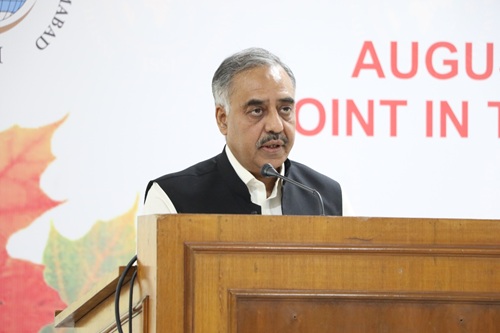
I welcome everyone to this Seminar marking six years since India’s unilateral and illegal actions of 5 August 2019 aimed at changing the internationally recognized “disputed” status of Jammu and Kashmir and altering the demographic structure of the occupied territory. These Indian actions were in complete violation of the relevant UN Security Council resolutions, bilateral agreement, and international law, particularly the 4th Geneva Convention. As such, these actions continue to be completely rejected by the Kashmiris and by Pakistan. As 27th October is remembered in Kashmir’s history as the “Black Day”, 5th August would always live in infamy as the “Youm-e-Istehsal.”
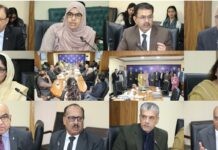
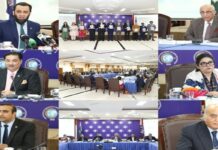
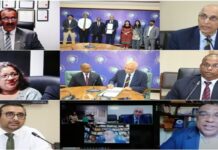
We are privileged to be joined, today, by eminent speakers from the academia, think-tanks, youth, and civil society. They will share their thoughts and perspectives from the political, legal and human rights angles. We are especially thankful to Mr. Muhammad Farooq Rahmani from the APHC and Ambassador Imran Ahmad Siddiqui, Additional Secretary (Asia-Pacific), from the Ministry of Foreign Affairs. It is an honour to have Sardar Masood Khan, distinguished diplomat and former President of Azad Jammu and Kashmir, gracing the occasion as the Chief Guest. Their insightful views would enlighten us all on the multiple dimensions of this subject and enrich the Seminar’s deliberations.
Distinguished participants,
5 August 2019 was indeed another turning point in the long and dark history of India’s illegal occupation, unabated repression, relentless political and legal manipulation, and gross misrepresentation of the situation in IIOJK. Ever since, the Indian occupied Jammu and Kashmir has remained the ‘most militarized zone’ in the world; the suppression of Kashmiris by Indian security forces has reached previously unseen scale; and the human rights violations escalated to the level of ‘crimes against humanity’ with ‘collective punishment’ of entire communities, especially during the cordon-and-search operations.
The Indian occupying forces have not just targeted the senior Kashmiri leadership or the Kashmiri youth, but also women and children, human rights defenders, and media personnel. From curfews to double lockdowns, and from information blackout to media crackdown, Kashmiris in IIOJK have been subjected to unspeakable brutalization. They have, however, endured all this with remarkable patience and equanimity. The Kashmiri resistance acquired new forms, including protest through silence. Most notably, despite all its wanton repression, India has neither been able to dampen the spirit of the Kashmiris nor break their will to fight for their inalienable right to self-determination.
During this period, India has also continued to pursue its sinister design of effecting a demographic change in IIOJK — seeking to turn the Kashmiri Muslim majority into a minority. This represents another unacceptable assault on the Kashmiris’ rights, their land, and their distinct cultural identity. Property laws have been changed and tens of thousands of domicile certificates issued to non-Kashmiris to buy property and to settle in the state. Indian diplomats have unabashedly advocated replicating the Israeli model; i.e., implementing a settler-colonial project. This has been accompanied by wide-ranging electoral engineering to manipulate outcomes in any future polling exercise. Far from providing any relief and justice, the Indian Supreme Court in a most questionable verdict endorsed the Indian government’s actions of 5 August 2019.
Unable to control the resistance movement by force, India has also been at its familiar ploy of branding the indigenous Kashmiri struggle as “terrorism” and accusing Pakistan of complicity in the so-called “cross-border terrorism.” The Pahalgam attack of 22 April 2025 was similarly manipulated to advance this malicious agenda and unleash military aggression against Pakistan. Pakistan’s swift and strong response effectively stemmed this Indian onslaught. However, Indian political leaders continue to contend that there is only a “pause” and that Operation Sindoor continues in different forms. It is clear that the Hindutva-driven BJP-RSS regime remains focused on a willful global smear campaign against Kashmiris and Pakistan and follow what it terms as a ‘muscular’ approach. It has also weaponized water and illegally put the Indus Waters Treaty “in abeyance.” It has evidently no interest in stability and peaceful co-existence.
For its part, Pakistan remains steadfast in its solidarity with the Kashmiri people and support for their just cause. The Palestinian experience illustrates that suppressing the legitimate rights of a people and leaving a dispute unresolved for a long time has huge costs in terms of regional and international peace and security. Everyone, including India, needs to recognize that Kashmir is a dangerous flashpoint and that durable peace and stability in South Asia remains contingent upon peaceful resolution of the Jammu and Kashmir dispute. This reality was strongly underscored by Pakistan during it just-concluded Presidency of the Security Council in July 2025. Pakistan spearheaded the unanimous adoption of the Security Council Resolution 2788 (2025), reinforcing commitment to peaceful settlement of disputes and calling for the implementation of UNSC resolutions. Pakistan remains determined to extend all possible support to the Kashmiris for the realisation of their right to self-determination in accordance with the UN Charter and relevant Security Council resolutions. Besides being a historic obligation, this is a moral and strategic imperative for Pakistan. Pakistan would never flinch from this commitment.
The role of the international community remains equally indispensable. It could ignore the simmering situation in IIOJK only at its own peril. It would be prudent to draw the necessary lessons from the Palestinian issue and take steps to help resolve the Kashmir dispute in a timely manner. We must remember that as there can be no peace in the Middle East without justice for the Palestinians, there can be no peace in South Asia without justice for the Kashmiris. The international community, including the UN Secretary General and the Security Council, must fulfill their respective responsibilities. Faithful implementation of the Security Council Resolutions on Jammu and Kashmir is essential if this long-standing scar on the conscience of humanity is to be removed and sustainable peace established in this most dangerous part of the world.
To conclude, given India’s obstinacy and intransigence, it is only through the collective endeavours of Kashmiris, Pakistan, and the world community, that a just and lasting solution can be ensured. Pakistan must proceed on this path with renewed vigor and resolve, backed up by a strong national consensus and support of all segments of our society. There is no doubt that success will eventually come, InshaAllah! I recall again what Faiz Sahib had said, lumbi hai gham ki shaam, magar shaam hi tou hai!
I thank you!