





Remarks by DG ISSI Ambassador Sohail Mahmood at Seminar
“SCO’s ‘China Year 2025: Upholding the ‘Shanghai Spirit’”
ISSI, 22 August 2025
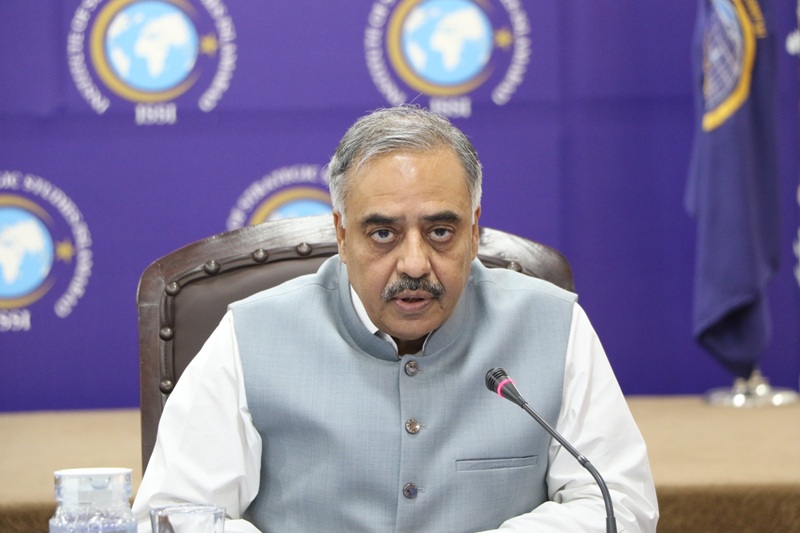
It is a great pleasure to welcome everyone to the ISSI for this seminar on “SCO’s ‘China Year 2025: Upholding the ‘Shanghai Spirit.’” This seminar has been organized in the run-up to the 25th SCO Heads of State Summit, being held in Tiajian, China, next week. We have a set of eminent speakers — including practitioners, academics, and area specialists — to reflect on how the SCO, under China’s Presidency, is consolidating its gains, deepening its agenda, and enhancing its global salience.
Over the past 25 years, SCO has evolved into one of the world’s most comprehensive and dynamic multilateral platforms. With membership encompassing nearly half the world’s population and accounting for 25% of the global GDP, SCO’s global relevance is firmly established. From its inception as the ‘Shanghai Five’ in 1996 to its steady expansion into a trans-regional Organization that now includes 10 Member States, 2 Observers and 14 Dialogue Partners, SCO is a compelling example of multilateralism in action. This also illustrates its open, inclusive and forward-looking character.
The ‘Shanghai Spirit’ serves as the guiding principle and a binding force for the SCO. This spirit — built on trust, equality, consultation, mutual benefit, respect for cultural diversity, and the goal of shared progress — has allowed countries with very different systems, economies, and security priorities to work together meaningfully. In an era marked by accentuating geopolitical tensions and growing conflicts, the ‘Shanghai Spirit’ offers an alternative vision of multilateralism — one based on dialogue rather than dominance, consensus rather than confrontation, and collective prosperity rather than unilateral gains.
Distinguished participants,
The assumption of SCO Presidency by China for the period 2024–2025 is especially significant. Beijing crafted a comprehensive agenda that encapsulates both continuity and innovation in the SCO’s trajectory. At the meeting of the Council of Ministers in Tianjin in July 2025, Foreign Minister Wang Yi laid out a five-point roadmap for the SCO’s future development. This roadmap is both forward-looking and deeply rooted in the ‘Shanghai Spirit.’ It calls, first, for carrying forward the SCO’s founding mission and reinforcing solidarity among its members. Second, it emphasizes consolidating the foundations of collective security against the “three evils” of terrorism, separatism, and extremism, while also addressing new and non-traditional challenges such as cyber threats and regional instabilities. Third, it underscores the pursuit of win-win economic cooperation — through trade, connectivity, industrial partnerships, digital economy, and green development. Fourth, it stresses fostering good-neighbourliness and building a community of shared destiny. And, fifth, it calls on the SCO to uphold multilateralism, defend fairness and justice, and contribute to equitable global governance, particularly at a time when the United Nations marks the 80th anniversary of its establishment this year.
China has thus set the stage for an SCO that is more cohesive, more resilient, and more responsive to the demands of a changing world order. This momentum will culminate at the 25th Summit in Tianjin on 31 August-1 September 2025, where Leaders will come together to adopt the Tianjin Declaration and a long-term development strategy. The outcomes of this Summit are expected to chart the SCO’s direction for the next decade, reinforcing its role in promoting peace, security, connectivity, and cooperation in the vast geostrategic space of Eurasia.
Excellencies,
Distinguished participants,
For Pakistan, SCO represents a trans-regional platform of immense value. Our membership since 2017 has enabled us to engage constructively with regional partners on issues of common concern. Pakistan has consistently underscored the need to enhance security cooperation to counter terrorism and transnational threats; to deepen economic integration by leveraging connectivity projects such as the China-Pakistan Economic Corridor (CPEC); and to expand cultural and educational exchanges that strengthen the bonds between the peoples.
In particular, Pakistan has advocated for coordinated international support for Afghanistan’s stability and reconstruction — an imperative for ensuring peace and prosperity across the SCO region. We are equally committed to working with China and all SCO partners to alleviate poverty and to promote inclusive development, food security, technological innovation, green energy transitions, and regional connectivity that will bring long-term benefits to our societies. Pakistan’s successful hosting of the SCO Council of Heads of Government meeting in 2024 showcased its constructive role in advancing this agenda.
Going forward, it is also important to acknowledge the challenges that SCO faces. Major-power competition, geopolitical tensions, environmental issues such as water scarcity, and intra-member divergences on policy and key initiatives require sustained attention and efforts. Effectively tackling the Organization’s immense diversity and at times differing perspectives of member states is essential to ensure close coordination for result-oriented practical cooperation. With political will and institutional innovation, the SCO can continue to evolve and deliver tangible outcomes for its members.
As Pakistan’s premier think-tank, ISSI remains committed to supporting these endeavors through dedicated research, dialogue, and outreach. In this spirit, I am delighted to share that the upcoming issue of our “PIVOT” magazine will be dedicated exclusively to the SCO. It will highlight policy perspectives, emerging opportunities, and practical recommendations to further strengthen SCO cooperation and enhance Pakistan’s engagement. The special issue will also serve as an important resource for academics and practitioners to better understand the evolving trajectory of the SCO and the way ahead.
Let me conclude by emphasizing that the theme “SCO’s China Year 2025: Upholding the Shanghai Spirit” is not merely a slogan — it is a call to collective action. It reminds us that the strength of the SCO lies in unity amidst diversity, in trust amidst challenges, and in cooperation amidst competition. By upholding the ‘Shanghai Spirit,’ and by supporting the initiatives under China’s Presidency, we can ensure that the SCO continues to serve as a beacon of stability, inclusivity, and shared progress in an uncertain world.
I look forward to rich contribution from our esteemed speakers and wish fruitful deliberations during the Seminar.
Thank you.