








Remarks by DG ISSI Ambassador Sohail Mahmood at the Launch of Mr. Saud Sultan Book, Jammu and Kashmir – The Forgotten Narrative,
ISSI, 21 October 2025
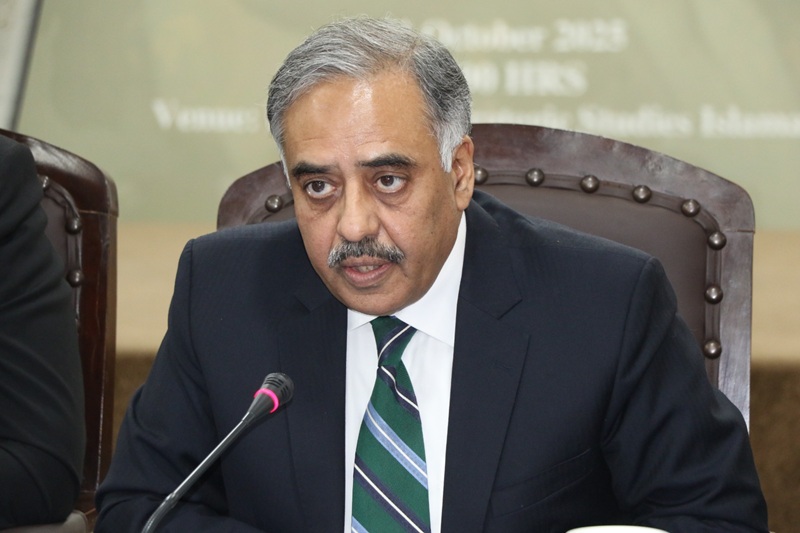
Let me begin by extending a warm welcome to everyone to this launch of Saud Sultan’s book, Jammu and Kashmir – The Forgotten Narrative: From Distorted Origins to Denied Freedom. Besides the author himself, we are privileged to have a number of distinguished speakers including APHC’s Convener Mr. Farooq Rahmani and former President of AJK Ambassador Sardar Masood Khan. Apart from their high achievements in scholarship, diplomacy, and politics, their contributions to the legitimate Kashmiri struggle for self-determination are invaluable. We look forward to their insightful views on the book and its subject-matter.
It is an honour to welcome former Chairman Joint Chiefs of Staff Committee (CJCSC), General Zubair Mahmood Hayat, to the ISSI again. He has rendered illustrious services to the nation throughout his long and distinguished career. Besides being a highly decorated soldier and commander, General Zubair is a widely acknowledged strategic thinker, who has made a distinct contribution to strategic thought in Pakistan. He has also been one of the most ardent supporters of the Kashmir cause. Moreover, no one knows and interprets the dynamics of the Hindutva ideology in India, and its strategic consequences for the region, better than General Zubair Hayat. It would be a real privilege to hear his perspective on our topic today.
Distinguished participants,
Saud Sultan is a young scholar who, in my reckoning, has made a substantial contribution to the historiography of Jammu and Kashmir dispute. Scion of a prominent Kashmiri family in AJK, he has completed his M.Phil from the world-renowned Cambridge University. It would not be an exaggeration to say that Kashmir is part of Saud’s DNA, representing as he does the third generation of his family in the service of this just and noble cause. He feels Kashmir in his bones. But his treatment of this subject is not emotional. Steeped in the British academic tradition of rigorous research, he has made a strenuous effort to write an objective account of some of the most consequential episodes in this long-running saga. Drawing on extensive archival material, unearthing long-suppressed accounts, and accessing first-hand testimonies, Saud Sultan has furnished an historical interpretation with near clinical precision. He has been at pains to make sure that his Kashmiri origin and identity, and his passion for his homeland, do not interfere with his obligations as a researcher and academic. Not only that his sources are primarily non-Kashmiri and non-Pakistani, i.e. foreign and Indian, but also he has developed this book under the stringent scrutiny of Ms. Victoria Schofield – a highly demanding mentor and an internationally-recognized Kashmir scholar in her own right. As you would read from the book, the end product is truly impressive.
At the heart of the book is a careful review of the crucial weeks and months around the Partition of British India in August 1947 and the origins of the Jammu and Kashmir dispute. Contrary to common narrative peddled ad nauseam by India that presents the conflict as a result of an alleged “tribal invasion” from Pakistan, the author makes the compelling case that the seeds of discord had been sown much earlier. Among others, it was rooted both in the indecision of the State’s Dogra ruler Maharaja Hari Singh, and his abject failure in honouring the will of the State’s majority Muslim population. In the weeks after the Partition, the Maharaja – driven by his personal ambitions and a desire to maintain autonomy – allowed the situation to spiral out of control. Had the Maharaja made a timely and principled decision, respecting the wishes of the people, the history of South Asia would have taken a vastly different course.
In my view, the book contains five major contributions:
First, a detailed examination of the Jammu massacre of 1947, a horrific event that has either been neglected or purposely erased from history in the Indian narrative. The author has drawn upon reliable international sources to show that over 200,000 Kashmiris in Jammu were killed and 300,000 pushed out to Pakistan or elsewhere. These killings and forced migrations were not spontaneous outbursts of communal violence. Instead, the book reveals that this was the outcome of a calculated and orchestrated operation as Hari Singh wanted to change the demography of Jammu by reducing its Muslim majority. Arms were distributed among communal Hindus and RSS volunteers along with Sikh refugees from West Punjab. Fleeing Muslims were assured of safe conduct to Pakistan, but were killed at a place called Saubha. The massacre did radically alter the demography of Jammu.
Second, the book debunks the official Indian narrative that New Delhi’s intervention was primarily in response to the alleged “tribal invasion” supported by Pakistan. The Government of India’s complaint to the United Nations in January 1948 is premised in this false assertion. The author highlights several facts that were either omitted in the GOI memorandum – such as the Jammu massacre and the fierce indigenous Kashmiri resistance in Poonch and Mirpur against Dogra rule and establishment of the State of Azad Jammu and Kashmir on 24 October 1947 – or manipulated – such as laying the blame exclusively on the arrival of the tribesmen. The author recounts that the Jammu massacre, the Poonch and Mirpur armed rebellion and its brutal repression by State forces and their accomplices, and a military intervention plan hatched by Home Minister Sardar Patel in New Delhi, were among the principal factors. When the people of Poonch got a wind of the planned military intervention, they called in the tribesmen. Thus, Pakistan was in no way the ‘instigator’ as alleged by India.
Third, the book asserts that India was the country that invaded Kashmir, while it shouted from rooftops that Pakistan was culpable. The author shows that before the arrival of the ‘tribals’, the Patiala State Forces and Akali Sikhs, along with workers of the RSS, were already busy killing Muslims, particularly in the Jammu region. Since the State of Patiala had already acceded to India, the presence of Patiala State Forces meant that India had entered the State to wrest control. In its memorandum to the UN, India completely glossed over these facts and instead raised the bogey of Pakistan-backed tribesmen ‘invading’ the State.
Fourth, the book debunks the Indian narrative of the Maharaja signing the Instrument of Accession before the landing of Indian forces in Kashmir. The author proves that the Instrument was not signed on 26th of October, as claimed by New Delhi. This is something that British historian Alastair Lamb has also convincingly demonstrated through his own meticulous research. The upshot is that, contrary to whatever the Indian government has consistently propagated, there was absolutely no legal basis for a military intervention when the Indian forces landed in Srinagar on 27 October 1947. That day, now remembered as the ‘Kashmir Black Day’, will always live in infamy.
Fifth, the book presents a stark contrast in the experiences of Kashmiris living free in Azad Jammu and Kashmir and those living under illegal occupation in IIOJK. The author highlights religious, political, and cultural freedoms enjoyed in AJK as compared to the unspeakable suffering endured by Kashmiris in IIOJK stemming from discrimination, harassment, security operations, and draconian laws used by the occupation forces with impunity. While these sharp differences have always been known, it is to the credit of the author that he has presented data and based his conclusions on evidence.
In a nutshell, Saud Sultan has shown that the roots of the conflict are neither simple, nor one-sided. Rather, they are complex, multi-layered, and deeply historical. In his own words, this book is “grounded in evidence, documentation, and lived experiences.” He has rendered a commendable service by unveiling new information and evidence, bridging existing gaps in the Kashmir historiography, and opening avenues for further inquiry and research. By challenging an inaccurate, motivated and partial version of history, Saud Sultan has contributed to a growing body of critical literature that calls for a rethinking of myths, not just for academic purposes but for the practical necessity of peace and justice of a long-suffering people. It is hoped that the ‘forgotten narratives’ will be revived and that these would also serve to awaken the conscience of humanity. Nothing short of the fate of millions of Kashmiris is at stake.