




Remarks by Director General ISSI Ambassador Sohail Mahmood
at International Seminar on
“Pakistan–China Relations: Regional Stability and Economic Prosperity”
ISSI, October 6, 2025
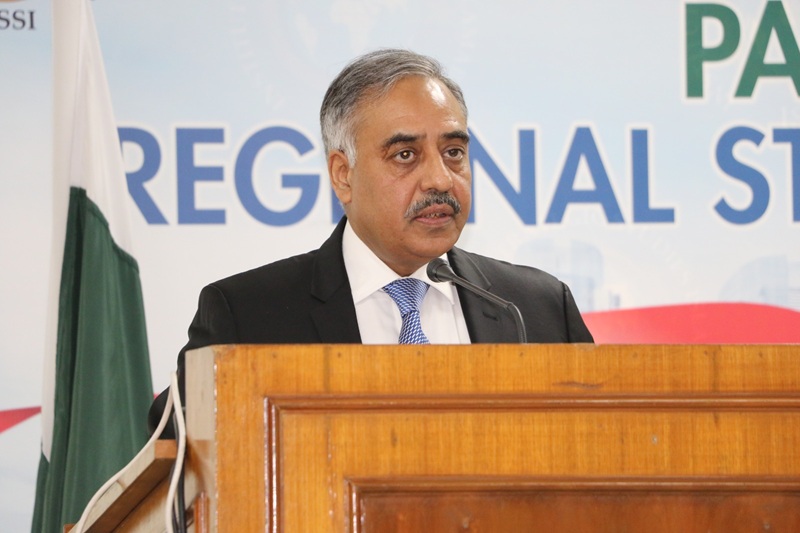
It gives me immense pleasure to welcome everyone to the Institute of Strategic Studies Islamabad (ISSI) for this International Seminar on “Pakistan–China Relations: Regional Stability and Economic Prosperity.” Allow me, at the outset, to extend our warmest felicitations to all our Chinese friends on the National Day, celebrated on 1st October 2025.
Let me also convey our deep appreciation to the eminent scholars and academics from different Universities in China, who have travelled to Pakistan and are participating in this important discourse. In the strategic arena, China’s peaceful rise is one of the most consequential developments of our times. This rise is most evident in China’s remarkable economic growth, mounting military prowess, and outstanding technological advancement. All this has become possible because of the massive investments that the People’s Republic has made over decades in the fields of education and science & technology. Today, Chinese Universities like Fudan, Peking and Tsinghua are outshining world renowned institutions like Oxford, Cambridge, Harvard, and MIT. It was not long ago when the Economist declared China as the ‘scientific superpower’ of the world – surpassing the U.S. and Europe in high-impact scientific publications, and demonstrating dominance in applied sciences, AI, and engineering. So we are truly privileged to have these scholars from illustrious Chinese Universities visiting Pakistan and engaging with us on the Pakistan-China relationship and its regional import.
I also take this opportunity to sincerely thank the senior diplomats, practitioners, and academics from Pakistan taking part in this International Seminar as Session Chairs, Speakers, and discussants. Our special gratitude is due to Ambassador Imran Ahmed Siddiqui, Additional Secretary (AP), at the Foreign Office for taking the time out and gracing the occasion as Chief Guest. We would all benefit enormously from the cumulative wisdom of the esteemed speakers from China and Pakistan.
Distinguished participants,
Pakistan has always regarded its relationship with China as the cornerstone of its foreign policy. The relationship is described as all-weather, time-tested, and iron-clad. These may appear to be high-sounding clichés, but they truly reflect a profound reality: This is a relationship built over more than seven decades on the basis of mutual respect, strategic mutual trust, and mutual support for each other’s issues of core interest. Unique in inter-state relations, this partnership continues to grow from strength to strength — as each successive generation in Pakistan and China makes its own contribution to nurture it further. Besides helping to promote the common goals of peace and development, it serves as a major factor of stability in the region and beyond.
The evolving global and regional environment has placed new responsibilities on both the countries. The challenges before us – ranging from geo-political flux, global economic uncertainty, food and energy insecurity, and the impacts of climate change, to persistent threats posed by wars and armed conflict, terrorism, and new forms of major-power competition – underscore the need for deeper collaboration among partners who share a common vision of peace and development as well as a just and equitable global order.
Pakistan and China have consistently worked for the realization of these noble goals. Together, they have promoted dialogue and peaceful resolution of disputes, opposed unilateral and coercive approaches, rejected bloc politics and zero-sum mindsets, and supported multilateralism based on international law and the purposes and principles of the United Nations Charter. It is evident that the more the polarization and fragmentation in the world, the greater the salience of a strong and stable China-Pakistan partnership.
This partnership is also manifest in our shared desire to build a cooperative world. Pakistan fully supports President Xi Jinping’s Global Development Initiative (GDI), Global Security Initiative (GSI), Global Civilization Initiative (GCI), and the latest Global Governance Initiative (GGI). Taken together, these landmark initiatives represent China’s alternative vision for a peaceful, stable and cooperative world. They also align with Pakistan’s commitment to UN-centered multilateralism, inclusive and sustainable growth, equal and undiminished security for all, peaceful co-existence, and effective multilateral governance institutions.
Pakistan and China also share a commitment to amplifying the voice of the ‘Global South’, promoting equity and justice in the international system, and striving for a world order that is more representative, inclusive, and reflective of the aspirations of developing nations.
Distinguished participants,
On the bilateral plane, economic cooperation is one of the most vital dimensions of the Pakistan-China relationship. The China-Pakistan Economic Corridor (CPEC), the flagship project of the Belt and Road Initiative (BRI), is a manifestation of our efforts for regional connectivity, common development, and shared prosperity. Over the past decade, CPEC has transformed Pakistan’s development landscape. It has addressed critical energy shortages, upgraded transport and logistics infrastructure, created tens of thousands of jobs, and opened new avenues for regional trade and investment. We are now entering a new phase – CPEC 2.0 – with a focus on industrial development, SEZs, agriculture, mining, science & technology, Information Technology, and renewable energy. This phase will further consolidate the foundation for Pakistan’s sustainable growth, while contributing to regional trade, connectivity and economic integration — potentially extending to Afghanistan, Central Asia and the Middle East.
The landmark ‘Action Plan to Foster an Even Closer China-Pakistan Community with a Shared Future in the New Era”, adopted last month, outlines an elaborate roadmap for the next five years (2025-2029). It identifies specific actions and targets to be accomplished in five major domains: practical belt and road cooperation; economic, trade and financial cooperation; cooperation in science, technology, and human resources; security and defence cooperation; and people-to-people exchanges. The Action Plan also envisages collaboration on Pakistan’s key priorities such as green transition, digital transformation, and cooperation in critical fields like Artificial Intelligence, cyber, and space.
In terms of regional connectivity in the eastern direction, Pakistan-China collaboration is of equal importance. The dysfunctionality of SAARC has caused a serious dent in the architecture of regional cooperation. As part of fresh thinking and reimagining, a Bangladesh-China-Pakistan trilateral mechanism has recently been created to promote mutual cooperation in agreed areas. More such formats can be developed. Most South Asian countries are already members of the BRI and China’s economic engagement with them is steadily growing. At a high-level seminar, hosted by the SIIS in Shanghai last month, participants deliberated on the future trajectory and scope of ‘China-South Asia cooperation’ and came up with a range of useful ideas. I take this opportunity to reiterate our own proposal for the establishment of a ‘China-South Asia summit process’ on the analogy of China-Central Asia and China-GCC formats. This will provide a suitable platform for advancing mutually-beneficial collaboration for trade, investment, connectivity, tourism, culture, youth empowerment, media, and people-to-people links. There is indeed compelling logic for such engagement, and it should be embedded in the unexceptionable principle of “open and inclusive regionalism.”
Within the framework of joint “Action Plan”, Pakistan and China have reaffirmed the commitment to deepen defence and strategic cooperation and to continue to work together to promote regional peace and stability. The Pakistan-China strategic partnership already focuses on defence, security, and counter-terrorism cooperation – areas central to promoting peace and stability in the wider region. Both sides have stood shoulder-to-shoulder in confronting common security challenges, with China consistently acknowledging Pakistan’s immense sacrifices in the fight against terrorism.
In the regional context, the broader issues related to Afghanistan, Iran, and India-Pakistan keep commanding the international community’s attention. The 4-day India-Pakistan conflict in May 2025, for instance, raised global concerns and was contained primarily with international involvement. In its wake, it highlighted serious risks relating to strategic stability and potentially dangerous escalation. It also amplified the serious gap that exists in the shape of missing frameworks for conflict management and dispute resolution. The regional countries should see how initiatives like the GDI, GSI, GCI, and GGI can be leveraged to help address South Asia’s multiple deficits in development, security, and the architecture for regional cooperation. It is important to work with partners like China to explore how dialogue and cooperation can be fostered and the worthy goals of peaceful co-existence and win-win solutions advanced.
Distinguished participants,
As we prepare to celebrate the 75th anniversary of Pakistan–China diplomatic relations in 2026, we must chalk out an elaborate programme of activities in both countries to mark not just our historic achievements but also craft a forward-looking vision for the future. In 2047, Pakistan will celebrate the centenary of its Independence; in 2049, China will mark the centenary of the People’s Republic. Our new vision should cover the next 25 years – building on our strengths, adapting to the rapidly transforming world, and promoting a people-centered partnership.
In a nutshell, the road ahead is full of promise and possibilities. Together, Pakistan and China must continue to work for regional peace and stability, pursue sustainable development and connectivity, and strive to realize the dream of a shared future for our peoples and for the region.
On behalf of the Institute of Strategic Studies Islamabad, I once again extend my gratitude to all our distinguished participants for joining us today. We look forward to rich deliberations and meaningful exchanges during this Seminar.