








Remarks by Director General ISSI, Ambassador Sohail Mahmood, at Seminar on “The Future of Deterrence and Emerging Challenges”
May 28, 2025 | Youm-e-Takbeer
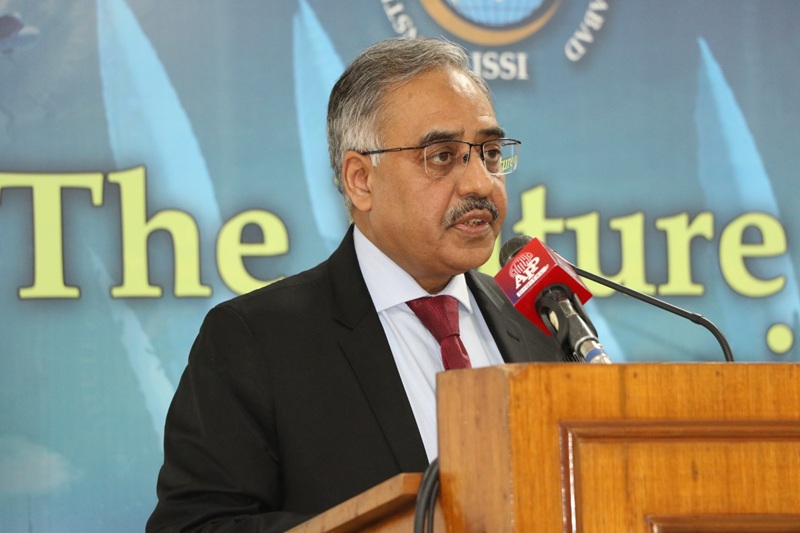
It is a distinct pleasure to welcome everyone to this Seminar on “The Future of Deterrence and Emerging Challenges.” In keeping with the ISSI’s established tradition, this Seminar has been organized to commemorate Youm-e-Takbeer.
We are privileged to have a panel of distinguished academics and practitioners including Dr. Salma Malik, Ambassador Zamir Akram, and Air Commodore Khalid Banuri. Each one of them has made an immense contribution to the policy process on strategic issues and helped defend Pakistan’s core interests. We look forward to hearing their insightful perspectives on today’s subject.
It is an honour to have Lt. Gen. Khalid Ahmed Kidwai, Adviser National Command Authority (NCA) and former Director General SPD, as our Chief Guest. Gen. Kidwai’s contribution to the development of Pakistan’s nuclear doctrine and strategy is second to none. His central role in this progressive evolution is universally acknowledged. The nation owes a debt of gratitude to him for his continued engagement with this critical and dynamic thought process – maintained with his quintessential humility, sagacity and wisdom. His discourse today, in the backdrop of recent post-Pahalgam events in South Asia, would be illuminating for us all.
Distinguished participants,
On this day, 27 years ago, Pakistan took the strategic and far-sighted step of responding in-kind to India’s 5 nuclear tests of 11 & 13 May 1998. Earlier, too, India had conducted a nuclear test explosion in May 1974. On 28 & 30 May 1998, Pakistan conducted a total of 6 nuclear tests and thus “settled the score.”
History is witness that Pakistan took the nuclear course only reluctantly, after India’s nuclear tests of 1974 and 1998 posed an existential threat to Pakistan and put South Asia inexorably on the nuclear path. Pakistan’s decision to nuclearize was driven solely by its legitimate security concerns — emanating from a nuclear India, increasingly belligerent in its posture and aggressive in its rhetoric and actions. Pakistan’s nuclear tests re-established deterrence and restored the strategic balance in South Asia. While demonstrating its technological prowess, the nuclear capability made Pakistan’s defence impregnable. The tests also illustrated the nation’s resolve that Pakistan would not be coerced, blackmailed, or dictated to.
Viewed within this context, Youm-e-Takbeer every year is an occasion for solemn rejoicing as well as thanks-giving. The people of Pakistan remember with pride and profound gratitude the generations of leaders, scientists, engineers, technicians, security personnel, strategists, and diplomats, whose dedication, single-minded focus, and sense of purpose helped accomplish this colossal task against the heaviest of odds. The Youm-e-Takbeer, in this sense, is also a time to celebrate the nation’s fortitude, resilience, and self-reliance and to reaffirm the determination never to flinch from safeguarding national interest in the face of any adverse development whatsoever.
From the day it acquired nuclear weapons capability, Pakistan has acted with tremendous restraint and responsibility. Several distinct strands are discernible in Pakistan’s policy and posture over the past 27 years. One, Pakistan has maintained a robust operationalized deterrent capability, despite India’s growing capacities and increased external support for its capabilities across a broad spectrum. Two, Pakistan has put in place an impeccable nuclear safety and security regime. Three, Pakistan’s credentials as a responsible nuclear state have been continuously reinforced internationally. Four, Pakistan has up-scaled the peaceful uses of nuclear technology in support of its economic development endeavors. Five, Pakistan has pursued active nuclear diplomacy to project its nuclear capability in its right perspective, counter disinformation and smear, and fight discrimination and double-standards in treatment of nuclear non-proliferation issues.
Distinguished participants,
The present phase of turbulence and transformation in the world is marked by a range of developments that serve to challenge deterrence stability at the global and regional levels. These include advancement of disruptive technologies, increasing role of Artificial Intelligence, advent of hypersonic missiles, persistent pursuit of ballistic missile defences, and growing complexity and integration of cyber and space domains. These technological developments are capped by accentuating geo-political contestations, erosion of long-established disarmament and arms control regimes, a renewed momentum towards nuclear weapons development in different parts of the world, and a specter of destructive arms races.
In our own region, strong technological and geo-political dynamics are at work, impacting both deterrence as well as our response options. Among others, these include India’s forays into advanced missile technology, including the deployment of MIRVs; deployment of Ballistic Missile Defence (BMD) systems; deployment of nuclear weapons at sea; increased missile tests, including systems exceeding 5,000 kilometers; and canisterized missiles and move towards a counter-force, launch-ready posture. This is way beyond the requirements of credible minimum deterrence. In effect, this posture betrays aggressive designs and ambitions for power projection beyond South Asia. Pakistan has anticipated these developments and taken necessary counter-measures to preserve the credibility of its deterrent.
India’s latest military misadventure against Pakistan in the aftermath of Pahalgam incident was yet another mindless attempt inspired by New Delhi’s deeply flawed and dangerous notion of space for limited conventional war under the nuclear overhang. This attempt, too, met with the same fate as the previous ones — with Pakistan responding with precision, calibration, and clinical perfection. While Pakistan was throughout confident of deterring India in the conventional domain, the world community was deeply alarmed that the conflict could escalate to the nuclear level.
Pakistan dominated in all domains — military, diplomatic, perceptions, and information. Faltering both on the ground and in the narrative, India resorted to wholesale fabrications. On the one hand, Indian news channels were conquering Pakistani cities; on the other hand, the Indian officialdom was hopelessly trying to deny any U.S. or third party role in the ceasefire. The spin meisters in Delhi have since sought to turn a visible military failure into a strategic victory of sorts for India. Frustrated with the turn of events, Indian leaders are in an overdrive, crassly threatening Pakistan and incessantly war-mongering.
It is clear that in the latest 4-day conflict with Pakistan, India has lost much more than 6 top-of-the-line combat aircraft; the country has lost international credibility, and its leaders any remaining sense of balance. This situation, too, is fraught with serious risks and there is no room for complacency or lowering our guard. The toxic Hindutva ideology, India’s long-standing hegemonic impulses, and the BJP’s electoral calculations could impel the regime in New Delhi to resort to yet more strategic recklessness. By the grace of Allah Almighty, the Pakistani nation stands united and our armed forces ready to thwart any act of aggression and safeguard Pakistan’s sovereignty and territorial integrity.
For its part, Pakistan has also consistently made clear that it will never allow space for aggression below the nuclear threshold. Our Full-Spectrum Deterrence, nested within the policy of Credible Minimum Deterrence, was conceptualized precisely to plug this perceived gap. The sooner India absorbs this lesson, the better.
It is hoped that India would have sober reflection on its ill-conceived actions and Pakistan’s resolute response and would draw the right conclusions. It is also imperative to stabilize the ceasefire, work on instituting a restraint regime and crisis management measures, and move towards resolving the long-standing Jammu & Kashmir dispute that remains the major driver of conflict in the nuclearized environment of South Asia.
While commemorating this Youm-e-Takbeer, let us remember that deterrence is not a doctrine of fear. It is a doctrine of stability, of responsibility, and of peace through strength. Pakistan did not choose the nuclear path lightly. But once we did, we embraced it with discipline, purpose, and resolve. Today, as the strategic landscape continues to evolve, Pakistan reaffirms that resolve with complete strategic clarity.
I thank you. And Youm-e-Takbeer Mubarak!