






Remarks by Director General ISSI, Ambassador Sohail Mahmood,
at the International Seminar
“Global Governance Initiative (GGI): China’s Vision of a Just and Fair Order”
ISSI, 29 September 2025
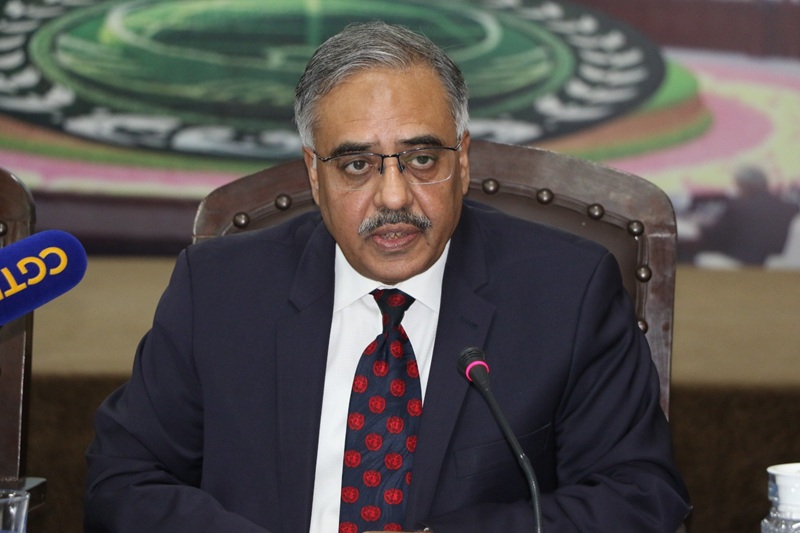
It is a distinct pleasure to welcome everyone to this International Seminar on the “Global Governance Initiative (GGI): China’s Vision of a Just and Fair Order.” The ISSI is delighted to hold this important event in collaboration with the China Media Group (CMG).
We are privileged to have a group of very distinguished speakers — including senior diplomats, practitioners, scholars, think-tank experts, and media persons. Our special thanks to our honoured guest from Bangladesh, Maj. Gen. (R) Fazle Elahi Akbar, Chairman, Foundation for Strategic and Development Studies (FSDS), joining as the Keynote Speaker. I also warmly welcome our Guest of Honour Counsellor Wang Shengjie from the Chinese Embassy. We are honoured to have former Minister for Information Mr. Murtaza Solangi, currently serving as the Spokesperson for the President of Pakistan. We would all stand to benefit enormously from the rich insights of the esteemed speakers and deepen our understanding of this 4th global initiative unrolled by President Xi Jinping in as many years since 2021.
I should also note that this is the ISSI’s fourth seminar of this series. Earlier, we have organized separate seminars on the Global Development Initiative (GDI), the Global Security Initiative (GSI), and the Global Civilization Initiative (GCI). These seminars have helped us engage both the research and policy communities in Pakistan on these landmark initiatives and assess China’s contribution in terms of addressing the key global deficits of peace, security, development, and trust.
Distinguished participants,
The “Global Governance Initiative” was announced by President Xi Jinping during his address to the SCO Plus meeting in Tianjin on 1 September 2025. Providing the context, President Xi noted that 2025 marks the 80th anniversary of both the victory of the World Anti-Fascist War and the founding of the United Nations. He underlined that while in the past 80 years the historical trends of peace, development, cooperation and mutual benefit have remained unchanged, the cold war mentality, hegemonism, and protectionism also continue to haunt the world. As new threats and challenges mount, the world finds itself in a period of turbulence and transformation. “Global governance has come to a new crossroads,” he emphasized. To move forward in these difficult times, President Xi stressed the imperative of working together for a more just and equitable global governance systems. Hence the GGI.
As outlined by President Xi, the GGI is based on 5 core concepts:
- Adherence to sovereign equality – Stressing that all states, regardless of size, strength and wealth, and particularly the developing countries, must be equal participants, decision-makers and beneficiaries in global governance.
- Abiding by international rule of law – Underscoring that the principles and purposes of the UN Charter and norms of international relations must be fully and uniformly observed by all.
- Practicing multilateralism – Underlining that the status and authority of the UN must be firmly safeguarded and its irreplaceable key role in global governance ensured.
- Advocating people-centered approach – Affirming the indispensability of reform and improvement of the global governance system to ensure that the people in every nation are the actors and beneficiaries of global governance.
- Focusing on real results – Emphasizing a systematic and holistic approach coordinating global action, mobilizing necessary resources, and ensuring visible outcomes through practical cooperation on urgent concerns of our times — from poverty alleviation to climate change, and from the digital divide to Artificial Intelligence and cyberspace and outer space.
In sum, the GGI seeks to inject greater inclusivity, democratization and effectiveness in the international system and in the international order. Specifically, it aims to address the under-representation of the developing world or the ‘Global South’; the erosion of international law and norms caused by unilateralism; and the palpable ineffectiveness of key global governance institutions in addressing the urgent issues of the times. In that sense, as rightly stressed by Foreign Minister Wang Yi, the GGI “comes at the right time, points the way forward, and demonstrates responsibility.”
The GGI also authoritatively repudiates the notion of China as a ‘revisionist’ power somehow bent on over-turning the post-WWII order. The Concept Paper on GGI, issued by the Chinese Foreign Ministry, makes clear:
“To reform and improve global governance does not mean to overturn the existing international order or to create another framework outside the current international order. Rather, the goal is to make the existing international system and international institutions better at taking actions, working effectively, adapting to changes, responding promptly and effectively to various global challenges, and serving the interests of all countries, particularly developing ones. No matter how the international landscape changes, China will remain firm in safeguarding the international system with the U.N. at its core, and the international order underpinned by international law, stand firmly on the right side of history, join hands with all progressive force in the world to build a community with ah shared future for humanity and make relentless efforts for mankind’s noble cause of peace and development.”
The GGI should also, undoubtedly, be seen as another important component of China’s evolving global role. President Xi’s three earlier, interconnected initiatives — the GDI, GSI, and GCI — address vital elements of the global agenda: namely development, security, and civilizational harmony. The GGI, with its focus on governance, fully complements its three predecessors. These initiatives have been well-received in most parts of the world, especially in the ‘Global South’, as they prove their value as global public goods. Furthermore, guided by Chinese wisdom, these initiatives represent an alternative vision of a stable and cooperative world in these times of turbulence and chaos. They also serve as the building blocks of a more just, equitable and multipolar order.
For its part, Pakistan has welcomed the GGI and reiterated its support at the highest level during the 80th Session of UN General Assembly in New York last week – stressing that it offers a comprehensive framework for a more just and inclusive development. In our perspective, the GGI will help strengthen the UN-centered multilateral system, enhance the role of developing countries in global governance, and accelerate progress toward the Sustainable Development Goals (SDGs). We also view it as a framework that complements and reinforces initiatives like the Belt and Road Initiative (BRI), with which Pakistan has an enduring partnership through the China Pakistan Economic Corridor (CPEC). Going forward, it would be important not only to utilize the SCO as a platform to promote GGI but also build new mechanisms such as ‘Friends of GGI’ and garner the broadest possible support of the UN membership.
Let me conclude by recalling what Foreign Minister Wang Yi recently said: “Facing a world of changes and chaos, China will continue to stand on the right side of history, on the side of human progress, and on the side of multilateralism, advocating unity and cooperation rather than division and confrontation.” This is the spirit with which Pakistan is fully aligned and stands ready to work with China, the United Nations, and the broader international community, to advance the objectives of the GGI and to build together a world with peace, prosperity, and a shared future for mankind.
Thank you.