




Remarks by Director General ISSI Ambassador Sohail Mahmood, at the ISSI’s 52nd Foundation Day Anniversary, June 30, 2025
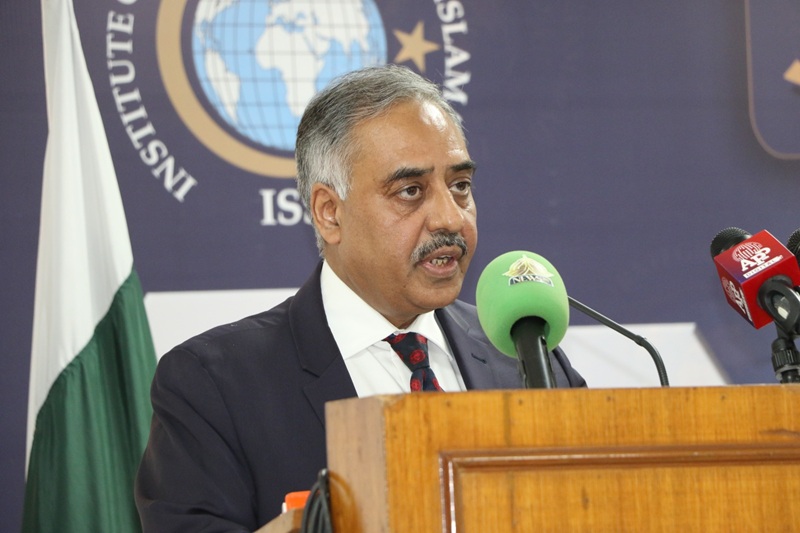
It is an immense privilege to welcome everyone to the Institute of Strategic Studies as we commemorate ISSI’s 52nd anniversary.
We are honoured by the presence of Honourable Deputy Prime Minister and Foreign Minister of Pakistan, Senator Mohammad Ishaq Dar, who is also the Patron of ISSI. Sir, your participation as chief guest accords special significance to this commemoration. We look forward to your reflections on Pakistan’s evolving role in a rapidly transforming global landscape.
We are also honoured by the presence of several eminent personalities who have contributed significantly during the ISSI’s long journey. On behalf of the ISSI family, I reiterate our abiding gratitude for their valuable contributions to the Institute’s evolution and emergence as Pakistan’s premier think-tank.
Excellencies,
Distinguished guests,
We are at present living through a proud moment in Pakistan’s history. In the aftermath of the Pahalgam attack on 22 April, India’s massive smear campaign, its slew of diplomatic, trade and economic measures including putting the Indus Waters Treaty (IWT) “in abeyance”, and its mindless military misadventure entailed formidable challenges for Pakistan. On its part, Pakistan was deliberate, responsible and resolute in responding to India’s belligerent posture and acts of aggression. Everyone — including the political and military leadership, members of the armed forces, diplomats, spokespersons, media personnel, civil society, and the youth — rose to the occasion. Our steadfast friends in the international community stood by us solidly, like a rock. Pakistan dominated the military, diplomatic and information domains, Alhamdolillah!
Pakistan’s fact-based narrative convinced the world, while the world re-discovered Pakistan with its multiple and multi-dimensional strengths. We note in all humility that Pakistan’s graph in terms of geostrategic salience is constantly rising — regionally and internationally. As we rejoice in this success, achieved by the grace of the Almighty and the valiant efforts of the whole nation, we must brace for the future with utmost prudence, confidence and clarity. Eschewing even an iota of complacency, we must be prepared for the yet more challenges that India might throw our way. We must also continue to fortify internal security, political stability, and the emerging economic growth trajectory. And we must be imaginative and proactive in realising the vast opportunities that have opened up for us in the region and across the globe in the wake of this achievement.
Distinguished guests,
In the backdrop of developments such as these, we can also better appreciate the growing role and relevance of think-tanks as an important pillar of the policy eco-system everywhere. Pakistan is no exception. Guided by the vision of Prime Minister Zulfiqar Ali Bhutto, this Institute was established in June 1973 as an autonomous and non-partisan Center for strategic research and analysis. Each phase in the Institute’s eventful journey has been marked by institutional growth, more intellectual rigor, and an unflinching commitment to advancing Pakistan’s strategic and foreign policy interests. The five Centres forming the core of ISSI’s institutional architecture cover the major global issues, with both geographical and thematic focus.
At the heart of the Institute’s work lies a professional and dedicated research faculty — constantly upgrading its information and knowledge, producing quality research, and contributing practical and forward-looking recommendations.
The ISSI has benefitted from the valuable support of the Ministry of Foreign Affairs — from the political leadership to the Foreign Secretary to her excellent team members.
The Institute also deeply appreciates the role of the Broad of Governors, led sagaciously by Chairman Ambassador Khalid Mahmood, and comprising distinguished professionals from different walks of life.
I take this opportunity to express our sincere thanks to the Ministry and the Board for being such pillars of strength for the ISSI and for upholding its autonomous and non-partisan character.
Since our 51st anniversary in June 2024, ISSI has pursued its mission proactively and with a sharp focus. We made consistent efforts to bridge the gap that traditionally exists between the research and policy communities; reinforced Pakistan’s foreign policy priorities; deepened our engagement with a diverse range of stake-holders; upgraded the quality of our research products; and expanded the depth and breadth of our national and international outreach.
The Institute remained in the vanguard of evaluating the complex regional and global developments and their impact on Pakistan. Among others, our research evaluations, policy discourse, and narrative-building endeavours covered a broad range of subjects, such as:
- Evolving global order and its implications for Pakistan.
- Major-power contestation and Pakistan’s policy options.
- Pakistan’s approach towards major powers — including the U.S., China, Russia, the EU, and Japan.
- Pakistan-China All-weather Strategic Cooperative Partnership and renewed momentum for CPEC.
- Pakistan’s role as a ‘Middle Power’ and key member of ‘Global South.’
- Pakistan’s pivotal contributions as an elected member of the UN Security Council (2025-26).
- Importance of deeper engagement with ASEAN, Africa, and Central Asia.
- Ongoing genocide in Gaza and Pakistan’s solidarity with Palestinians.
- Strategic stability and global non-proliferation and disarmament issues.
- Security dynamics of South Asia, including India’s continuing aggressive posture and the deteriorating situation in IIOJK.
- Rise of non-traditional threats such as climate change, environmental degradation, displacement and migration, and refugee crises.
- Nexus between emerging technologies and national security – with a special focus on AI, cyber-security, digital and maritime security.
- Countering Islamophobia, strengthening UN-centred multilateralism, and accentuating Pakistan’s pivot to geo-economics.
- Pakistan’s rich cultural heritage and growing ‘soft power’.
Over 165 events were organized during the past year (since June 2024), including pre- and post-COP dialogues, international conferences, seminars, webinars, and the 4th edition of ISSI’s flag-ship dialogue forum, the “Islamabad Conclave” – covering the afore-mentioned themes.
More than 180 Issue Briefs were published by the Institute during this period. Members of the Research Faculty also contributed 25 peer-reviewed research articles to other journals and wrote 5 book chapters.
The Institute commemorated key national and international days with special programmes — including International Day to Combat Islamophobia, International Women’s Day, Africa Day, Youm-e-Takbeer, International Environment Day, ASEAN Day, and the UN Day.
Our strong advocacy for a peaceful and just resolution of the Jammu and Kashmir dispute continued apace. Special sessions were organized marking the Kashmir Solidarity Day (5 February), Youm-e-Istehsaal (5 August), and Kashmir Black Day (27 October 27) and national discourse on this core issue was advanced.
Engagement with the youth as a key stakeholder on foreign policy and national security issues was deepened. Besides providing platform to NextGen IR scholars, an elaborate Internship programme has been instituted for University students from the twin cities and other parts of Pakistan.
The Institute held bilateral dialogues with high-level delegations from China, Central Asia, Iran, EU, Malaysia, Russia, Rwanda, and the U.S.
Following the example of “ASEAN Corner” established in 2023, ISSI added a “China Corner” and the “Kashmir Resource Centre” – making vast published and digital resources available to students, researchers and academics.
Strengthening collaborative partnerships with national and international counterparts, 20 MoUs were concluded during this period. The total number of such partnerships is now nearing 100.
Members of the Faculty also participated actively in prestigious international conferences and dialogue forums in different parts of the world – including Austria, Azerbaijan, Bangladesh, China, Germany, Iraq, Iran, Kazakhstan, Malaysia, Norway, Russia, Sweden, Switzerland, Turkiye, and Uzbekistan.
Above all, I am happy to announce that today we are presenting another five new Books to the Honourable DPM/FM that the Institute has published, piloted by our 5 Centers:
- Pakistan-China Relations: Connecting at the People’s Level (China-Pakistan Study Centre, CPSC).
- The Kashmir Question in a Changing World: Beyond August 2019 (India Study Centre, ISC).
- A New Era of Uncertainty: Emerging Technologies and Strategic Stability (Arms Control & Disarmament Centre, ACDC).
- Crossroads of Conflict: Transnational Terrorism from Afghanistan to Africa (Centre for Afghanistan, Middle East & Africa, CAMEA).
- Pakistan-Russia Relations: A Comprehensive Historical and Strategic Analysis (Centre for Strategic Perspectives, CPSC).
These Books shall be formally launched in separate events in the coming weeks and months, with the participation of authors and contributors.
I wish to close by paying a special tribute to the entire ISSI team – including the Directors, the Researchers, and the Administrative personnel – for their valuable contributions and for their unwavering commitment to take the Institute to further heights.
To our honourable guests, I reaffirm ISSI’s continued commitment to promoting meaningful policy discourse, enriching the policy process through insightful assessments and practical recommendations, and serving as a bridge between academic research and actionable policy.
I once again thank everyone for gracing this occasion and sharing our joy.
Thank you!