





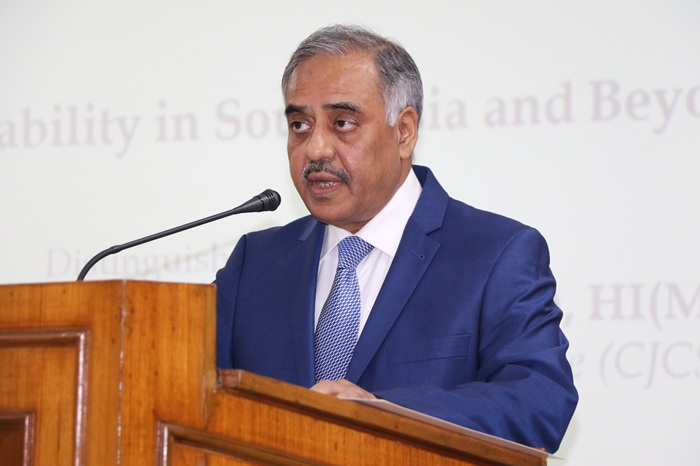
Remarks by Director General ISSI, Ambassador Sohail Mahmood, at Thought Leaders Forum, on “Peace and Stability in South Asia and Beyond”, featuring former Chairman JCSC General Zubair Mahmood Hayat, ISSI,
11 July 2025
It is a great pleasure and privilege to welcome everyone to today’s Thought Leaders Forum on the theme “Peace and Stability in South Asia and Beyond.” This edition of TLF takes place at a time when the global order is undergoing profound transformation — characterised by intensified major-power competition; massive rearmament and military modernisation drives; over-securitisation of key domains of human endeavour; violation of international law, the UN Charter, and established norms of inter-state relations with impunity; increasing unilateralism and protectionism; and steady erosion of multilateralism. Meanwhile, the existential threat of climate change and other non-traditional security challenges continue to exacerbate. New and emerging technologies and the attempts to put them to military uses are adding further layers of complexity. The regional dynamics are being deeply influenced and shaped by these shifting sands at the global level. They make today’s conversation not only timely, but indispensable.
Within this backdrop, it is an honour to welcome General Zubair Mahmood Hayat, former Chairman of the Joint Chiefs of Staff Committee, to the ISSI once again. Throughout his long and illustrious career, spanning over more than four decades, General Zubair Hayat has served the nation in various capacities with great distinction. His deep understanding of global transformation, his vast experience in the military and strategic issues, and his personal contribution to the formulation of policy as well as doctrines and strategies is a matter of public record. In his post-retirement phase, General Zubair Hayat has continued to influence the policy process through his thought leadership and wise guidance. We look forward to his illuminating address today.
Distinguished participants,
In May 2025, the security situation in South Asia once again reached dangerous levels of escalation and India and Pakistan could pull back from the brink only after hectic diplomatic efforts by some key countries that resulted in de-escalation and ceasefire.
The pattern was familiar: A terrorist attack in Indian Occupied Jammu & Kashmir; New Delhi’s rush to hold Pakistan responsible without any investigation and corroborating evidence; announcement of a slew of diplomatic, trade and economic measures; illegal and unilateral action to put the Indus Waters Treaty (IWT) “in abeyance”; and the threat to take decisive kinetic action.
Pakistan’s response was also along expected lines: Rejection of India’s baseless allegations; offer of an independent, credible and transparent investigation; reciprocal trade and economic counter-measures; declaration that diversion of river waters would constitute an ‘act of war’; a clear message to New Delhi to refrain from any military misadventure; and reaffirmation of resolve to safeguard sovereignty and territorial integrity.
For over two weeks after 22 April, the officially-inspired media in India smeared Pakistan and relentlessly war-mongered. Among other things, the resultant public sentiment mounted pressure on New Delhi for doing something drastic as it sought to grapple with the consequences of its ‘commitment trap.’ For its part, Pakistan repeatedly rejected India’s deeply flawed notion of “limited conventional war under the nuclear threshold” and advised against any misguided military action. But India chose not to pay heed.
The opening hours of the 4-day India-Pakistan war were the most significant: While India claimed – without evidence – of having targeted and destroyed alleged “terrorist infrastructure” in certain cities in Pakistan, Pakistan in internationally-acknowledged reports downed several of India’s top-of-the-line fighter jets. Between 7-10 May, the situation continued to escalate with the employment of stand-off weapons to drones to supersonic missiles. In its wake, Indian disinformation campaign peaked and outright lies of spectacular military successes against Pakistan were peddled by major segments of its media. The global anxiety also peaked in the mean time and several countries endeavoured to help India and Pakistan find an off-ramp.
Though the ceasefire was effected on 10 May, the Indian leadership called it only a “pause” and declared that “Operation Sindoor” continues in different forms. New Dehli insists that India has established a ‘new normal’ in its fight against alleged cross-border terrorism and that it would never yield to what is calls “nuclear blackmail.”
In Pakistan, there is a clear sense that it dominated in the diplomatic, information and military domains. Pakistan has stressed that it has once again successfully deterred India in the conventional domain and firmly set the ‘new normal’ of thwarting Indian aggression with a “quid pro quo plus” response. Pakistan has affirmed that the same approach will guide its response in case of any future aggression by India.
As we speak, the situation remains fraught with significant risks — marked by India’s shrill rhetoric, combative narratives, and mobilisation of resources for further military modernisation and new acquisitions. By all reckonings, this is the time for sober reflection. It is important for both countries to draw the right lessons from the conflict and its outcome, find ways of communicating with each other in a meaningful manner, take steps to stabilise the ceasefire and the overall situation, and move towards reliable crisis management mechanisms and eventually to dispute resolution.
Distinguished participants,
Beyond the centrality of the India-Pakistan question, peace and stability remain threatened in South Asia because of a range of other factors as well.
South Asia is one of the most challenged regions in terms of human development, intra-regional trade and economic integration, regional connectivity, and cultural and people-to-people links. It is also highly prone to natural disasters and frequently experiences extreme weather events. The only South Asia-wide platform for regional cooperation, SAARC, remains stymied due to Indian obstinacy.
In terms of hard security, South Asia has three geographically contiguous nuclear powers, massive concentration of armaments and regular induction of destabilising weapons systems, external support to trans-national terrorism, lack of regional institutions for crisis prevention or management, and no mechanisms for dispute resolution. In recent years, pan-securitisation has further aggravated the situation — with weaponisation of trade, water, sports, visas, and cultural exchanges. The multiple dimensions of the ‘Hindutva’ ideology including its concept of ‘Akhand Bharat’ have a disruptive effect. The unresolved Jammu and Kashmir dispute continues to be the cause of perennial tensions and conflict and a threat to durable peace and stability in the region.
The developments relating to cross-border terrorism from Afghanistan, the Iranian nuclear issue, and the intra-Gulf differences and disputes have further adverse consequences. The tragic situation in Gaza resulting from Israel’s relentless military onslaught is generating deep public resentment across the globe and could fuel conflict in the region. On top of all this, the U.S.-China rivalry is accentuating divisions and impacting the geopolitics in the region in a substantial manner.
In a nutshell, the turbulence and transformation marking the globe and the region pose formidable challenges for statecraft. It goes without saying that Pakistan would need to marshal all its capacities and prudently navigate this treacherous landscape. This would mean maintaining a robust defence capability to deter aggression and to keep the peace; and continuously pursuing proactive diplomacy to minimise the challenges and maximise the opportunities for development.
Our distinguished Thought Leader today would help us understand the complex dynamics of peace and stability in South Asia and beyond and suggest the best ways for Pakistan going forward. Let’s hear from General Zubair Hayat his prognoses and his prescriptions.
I thank you!