




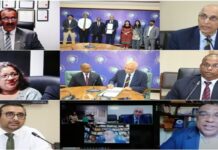
Remarks by Director General ISSI Ambassador Sohail Mahmood
on Launch of CSP’s Book “Pakistan–Russia Relations: A Comprehensive
Historical and Strategic Analysis”
ISSI, 18 November 2025

It is a distinct pleasure to welcome everyone to the ISSI for the launch of our latest book, Pakistan–Russia Relations: A Comprehensive Historical and Strategic Analysis. Our greetings to the distinguished participants joining us on-line as well.
We are privileged to have a set of highly distinguished speakers: Dr. Rasul Bakhsh Rais, a leading intellectual and academic voice and a former Director General of ISSI; Dr. Vyacheslav Belokrenitsky, a renowned Russian scholar and long-standing friend of Pakistan; Ambassador Qazi Khalilullah, an eminent diplomat and former Ambassador of Pakistan to Russia; and Ambassador Faisal Niaz Tirmizi, another dynamic diplomat and currently Pakistan’s Ambassador in Moscow.
It is a special privilege to have Excellency Albert Khorev, Ambassador of the Russian Federation to Pakistan, as the Guest of Honour. His presence testifies to the significance he attaches to this book project undertaken by the Institute.
Last but not the least, it is an honour to have Senator Mushahid Hussain Sayed, gracing the occasion as the Chief Guest. A former Minister, veteran journalist, leading parliamentarian, a thought leader, and a consistent advocate of Pakistan’s strategic diversification and Eurasian engagement. His distinguished, decades-long career includes invaluable contributions to better mutual understanding between Islamabad and Moscow and to the deepening of Pakistan-Russia relationship.
Distinguished participants,
In 2023, Pakistan and Russia celebrated the 75th anniversary of diplomatic relations. This journey has indeed been eventful. In the early decades of the Cold War, Pakistan and the Soviet Union found themselves on the opposite sides of the global divide. In the 1960s and 1970s, new possibilities emerged as mutual engagement expanded across different domains. The ‘Tashkent Declaration’ was a result of the Soviet mediatory efforts after the India-Pakistan war of 1965.
The Soviet Union also supported the process of Pakistan’s industrialization as well as infrastructure development – including the setting up of the Karachi Steel Mills and thermal power facilities at Muzaffargarh, Multan and Guddu. It also helped establishment of OGDC and assisted in the development of agriculture.
During the Afghanistan war in the 1980s, the bilateral relationship went through another challenging phase. However, since the end of the Cold War, a concerted effort has been underway by both sides to build the relationship on a broader and firmer basis.
We can confidently say that, today, Pakistan-Russia relations are marked friendship, cordiality, enhanced mutual understanding, and growing cooperation. Marking the 75th anniversary, Pakistan’s Foreign Ministry underlined that the two countries enjoy “close, multi-dimensional relations based on mutual goodwill and trust.”
In recent years, the pace of high-level exchanges has picked up significantly, including leaders’ meetings on the side-lines of multilateral summits. As we speak, Deputy Prime Minister/Foreign Minister Senator Ishaq Dar is in Russia, attending the SCO Council of Heads of Government meeting.
There is a whole range of subjects across which the two sides are engaged. Besides the diplomatic and parliamentary realms, there are growing interactions in the fields of trade, energy, agriculture, security, counter-terrorism, and defence. Both sides distinctly recognize that there is still a vast potential to be realized.
Regionally, Pakistan and Russia have been working to promote the shared objectives of peace and stability in Afghanistan. Both countries want the menace of terrorism and narcotic trafficking to be effectively countered and cooperate closely in this regard. There are also convergent interests on regional connectivity, including on crucial transportation corridor being spearheaded by Russia.
In the context of South Asia, a stable and peaceful region is in the interest of both countries. Russia’s traditionally close relationship with India has been a prominent factor in guiding Moscow’s approach towards the region. Pakistan has always stressed this should not be at the cost of Pakistan’s relations with Russia.
In the multilateral arena, Pakistan and Russia work closely at the UN in New York, Geneva, Vienna and elsewhere. On a large number of issues, the two countries hold similar views. Pakistan also appreciates Russia’s thoughtful position on the need to combat Islamophobia.
SCO is another key platform where Pakistan and Russia collaborate fruitfully. Russia’s support, along with that of China, was a determining factor in Pakistan’s full membership of SCO, to which Pakistan remains firmly committed as part of its growing engagement with the Eurasian region.
The conflict in Ukraine is another dimension of the global environment in which Pakistan-Russia relations have been evolving. Pakistan has taken a position of principle from the outset. It has consistently emphasized the fundamental principles of UN Charter and stressed the imperative of a resolution through dialogue and diplomacy.
It may be underlined that Pakistan recognizes Russia’s prominent place and role in the global order and develops this relationship as part of its policy to have good relations with all major powers. This approach enjoys consensus across the institutional spectrum in Pakistan. Given the recent developments, it appears that the relationship is poised to move forward and that the scope of cooperation will continue to grow. This is also dictated by the rapidly transforming global and regional environment and the imperatives of Pakistan’s pivot to geo-economics.
Excellencies,
Distinguished participants,
The edited volume we are launching today is a timely and substantive scholarly contribution. It brings together eminent Pakistani and Russian voices to provide a comprehensive, multi-dimensional assessment of Pakistan-Russia relations, from tracing historical foundations to mapping strategic engagements, defence cooperation, economic ties, energy and connectivity, cultural diplomacy, and collaboration multilateral platforms including the SCO and BRICS.
The book challenges outdated perceptions and highlights the growing convergence of interests between Islamabad and Moscow in the evolving multipolar environment. It underscores that Pakistan and Russia today are navigating shared opportunities in energy partnerships, regional connectivity, counterterrorism cooperation, and geo-economic integration across Eurasia.
Equally, the volume demonstrates the value of sustained academic collaboration, which serves as a strong foundation for durable international partnerships. The participation of esteemed contributors from the Institute of Oriental Studies, MGIMO University, HSE University and other Russian institutions reflects a shared commitment to building intellectual bridges and fostering deeper mutual understanding.
I wish to take this opportunity to pay a special tribute to all the contributing authors, whose deep expertise, rigorous research, and intellectual commitment have shaped this volume. Their chapters collectively span over seven decades of bilateral engagement, offering historical clarity, strategic insight, economic analysis, and forward-looking recommendations. This is a precious contribution to a crucial partnership that continues to evolve to the mutual benefit of both nations.
I am also particularly thankful to Dr. Neelum Nigar, Director of the ISSI’s Centre for Strategic Perspectives, for conceptualizing and leading this book project with exceptional dedication. The entire editorial team, including research staff and technical wing, deserve special acknowledgement for their outstanding work.
Let me conclude by once again thanking all our distinguished guests for honouring us with their presence. We look forward to a stimulating discourse and to the formal unveiling of this important book.
Thank you.