







Remarks by Director General ISSI Ambassador Sohail Mahmood
Thought Leaders Forum (TLF) with Air Chief Marshal (R) Sohail Aman
“Marka-e-Haq and Beyond”, ISSI, August 27, 2025
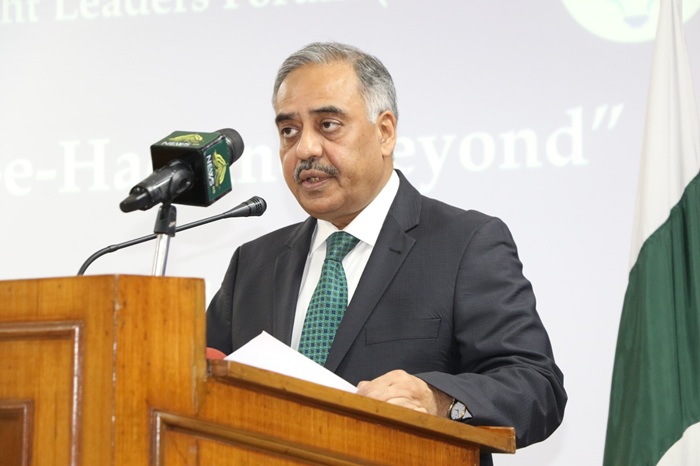
It is a real privilege to welcome everyone to this edition of ISSI’s Thought Leaders Forum (TLF). This is a series featuring thought leaders with an illustrious record of service to the nation in different domains. Earlier, we have welcomed on this platform eminent scholars, diplomats, servicemen, civil society activists, and faith leaders. Listening to their rich, insightful perspectives is always an elevating experience. Today, we have another distinguished speaker who would similarly inspire us with his deep knowledge and cutting-edge ideas.
It is an honour to welcome Air Chief Marshal Sohail Aman, former Chief of Air Staff (CAS). Besides his impeccable service as the CAS, Air Chief Marshal Sohail Aman possesses unmatched expertise in aviation and strategic affairs. Throughout his long and distinguished career — from a fearless fighter pilot to a pioneering Air Chief — he made invaluable contributions. As Air Chief, his special focus on indigenisation, high quality human resource, and strategic initiatives propelled the Pakistan Air Force (PAF) to newer heights. Many of the PAF’s recent successes, including in the domain of integrated warfare, have had their foundation in Air Chief Marshal Sohail Aman’s innovative concepts and transformational leadership. It would indeed by highly rewarding to hear his thoughts on ‘Marka-e-Haq and Beyond.’
Distinguished participants,
‘Marka-e-Haq’ is the latest manifestation of Pakistani nation’s robust response to unwarranted aggression and successful defence of the country’s sovereignty and territorial integrity. The armed forces of Pakistan, with the fullest backing of a united and determined nation, not only thwarted India’s reprehensible designs but also inflicted palpable damage on its capabilities as well as international image and credibility. Throughout the crisis period, from the Pahalgam terrorist attack of 22 April to the U.S.-brokered ceasefire of 10 May 2025, Pakistan dominated in all key domains – be it diplomatic or military or information.
In triggering this crisis, the BJP regime was driven by a toxic mix of Hindutva ideology, sinister electoral calculations, presumptions of military and technological superiority, misguided war-fighting doctrines, an unrelenting quest for regional hegemony, an exaggerated sense of India’s global salience, and an incalculable amount of hubris and arrogance. Without holding any worthwhile investigation or sharing even a shred of evidence, India felt it did not need to prove its case against Pakistan to the rest of the world. It got a rude shock. Its narrative or diplomatic manoeuvres found little traction; militarily, it got a bloody nose.
The opening hours of the 87-hour India-Pakistan war were the most significant. In what is being termed as the biggest air battle in history, with more than 100 aircraft mobilised on the two sides, the PAF once again proved its mettle. The downing of at least half a dozen top-of-the-line Indian fighter jets by the PAF set the tone for what was to come.
From a military stand-point, Pakistan’s Operation Bunyan-um-Marsoos marked a shift from the earlier confrontations with India. It demonstrated Pakistan’s capacity for integrated, multi-domain warfare. It integrated modern aerial confrontation, drone warfare, precision strikes, and joint command and control operations. Pakistan’s use of Fatah series precision missiles and loitering munitions reflected a departure from the attrition warfare logic of earlier decades. These precision systems targeted Indian command centres, Brahmos depots, and missile defence systems, signalling both technological maturity and doctrinal adaptability. Simultaneously, cyber disruption of Indian command and control systems illustrated Pakistan’s adoption of hybrid war domains, integrating non-kinetic methods with kinetic operations. The coordination across land, air, and cyber, enabled by real-time surveillance and joint command, can be termed as a move towards 21st century network-centric operation.
Above all, this was the triumph of courage, superior skills, and national resolve. It was proven again that India can neither impose its will on Pakistan nor establish any so-called ‘new normals.’ Further, that PAF’s air superiority is an established fact and that Pakistan’s quid pro quo plus (QPQP) response was robust and effective.
While hostilities were halted with the ceasefire, the situation remains fragile and fraught with risks. Regional stability is still threatened as India contends that there is only a “pause” and that ‘Operation Sindoor’ continues in different forms. There is also a deeply flawed and dangerous notion that India continues to peddle: There is space for limited conventional war under the nuclear threshold. For strategic stability, India need to be disabused of this false notion.
India’s illegal and unilateral action of putting the Indus Waters Treaty “in abeyance” is another cause for potential instability. Islamabad has made clear that any attempt by India to divert the flow of water and deny Pakistan its rights under the Treaty would be construed as an ‘act of war.’
The unresolved Kashmir dispute continues to be a flashpoint and a possible reason for further confrontation. Such volatility in a nuclearized environment is hardly conducive for sustainable peace in the region. The role of international community in stabilisation and conflict resolution remains indispensable.
Moving forward, sober reflection is required on all sides. Not only the right lessons must be drawn but also steps instituted to prevent the recurrence of such situations in the future.
From Pakistan’s perspective, constant vigilance and high level of preparedness are essential. The way India is militarily preparing itself after the May 2025 conflict, the Modi-led BJP government could well carry out some false flag operation for claiming a ‘win’ against Pakistan and accruing political and electoral dividends.
Pakistan has always shown restraint, but any near-future conflict could quickly result in an uncontrolled escalation spiral; therefore, it is imperative to be ready to retaliate swiftly and effectively to deter any Indian aggression.
In Operation Bunyan-um-Marsoos, Pakistan busted the myth of Indian conventional superiority and strengthened its conventional and nuclear deterrence. India has now unveiled its so-called ‘new strategic posture’ of ‘deterrence by punishment.’ This is a highly risky proposition, detrimental to regional peace and stability. On Pakistan’s part, maintaining credible deterrence requires constant improvements in capabilities. Pakistan must maintain its required technical and operational readiness in a multi-domain environment and plug any perceived gaps to respond to any future provocation and escalation. Pakistan also needs to modernize its military capabilities by focusing on indigenization to deal with India’s massive military modernization drive and its underlying motivations.
More fundamentally, focus on proactive diplomacy to establish conflict management and crisis stability mechanisms in the region is of vital importance. Ways have to be found for strengthening bilateral restraints, nuclear risk reduction, and confidence-building measures.
On all these matters, and much more including the future role of air power, our distinguished speaker has deep insights and strategic clarity. So I welcome Air Marshal Sohail Aman again and we look forward to hearing his thoughtful views. I thank you!