




REMARKS
SCO Secretary General Nurlan Yermekbayev
at the Institute of Strategic Studies Islamabad (ISSI) on the topic
“The SCO’s Role in the Changing Global Order”
(Islamabad, April 18, 2025)
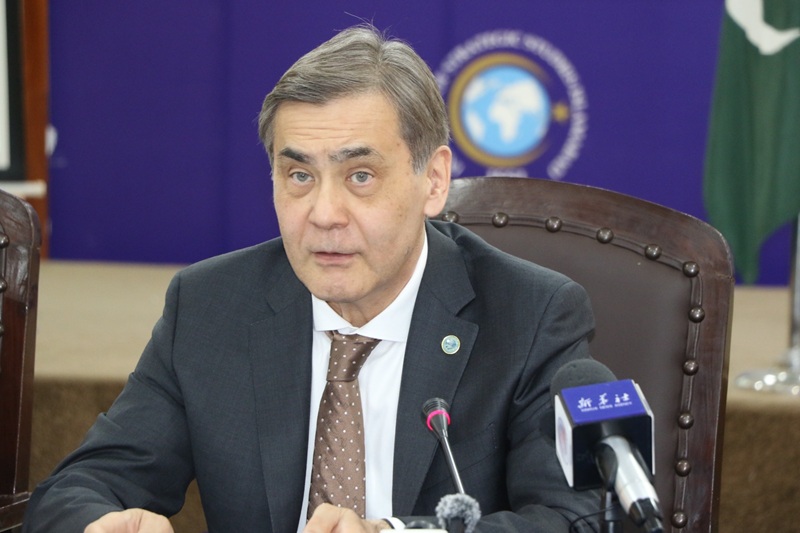
Esteemed Director-General, Ambassador Sohail Mehmood,
Excellences, Distinguished Scholars, Ladies and Gentlemen,
I wish to express my profound appreciation to the organizers of today’s event and to the Government of Pakistan for providing this opportunity.
I would further like to extend sincere gratitude for the warm hospitality and a chance to engage in a meaningful dialogue with distinguished scholars, diplomats, and policymakers. It is an honor to take the floor at such an important think tank.
This gathering is a testament of the enduring spirit of cooperation and shared aspiration for regional peace, stability, and development.
The topic of my speech is “The SCO’s Role in the Changing Global Order”. I will try to highlight multifaceted activities of the SCO, also emphasizing Pakistan’s meaningful contribution to the development of multilateral relations, as well as present the existing potential for progressive cooperation.
Today, the world is going through an era of significant changes affecting all aspects of international relations, from politics to economics. Against the backdrop of these transformations, a new world order is emerging, opening up wide opportunities for the development of countries and strengthening partnerships. The heads of the SCO Member States put it this way: “The Member States consider it necessary to enhance the SCO’s role in creating conditions for strengthening universal peace, security and stability, as well as building a new democratic, just, political and economic international order”.
Under these conditions, the role of the Shanghai Cooperation Organization is of particular importance. The choice made by the SCO Member States at the beginning of the 21st century has become a vivid example of the harmony of good-neighborly and cooperative relations and continues to serve as evidence of the strength and steadfastness of the “Shanghai spirit”.
We often speak of Shanghai Spirit, but what does it mean? Particularly, featuring mutual trust, mutual benefit, equality, consultation, respect for cultural diversity and pursuit of joint development.
The SCO provides a unique platform for dealing with regional and global challenges, such as security, economic development and cultural interaction. Given the context of the growing competition among multilateral formats, the SCO plays an important role in supporting stability and strengthening mutual trust between States. The word, competition, here is being used in a positive sense. Competition means that the SCO needs to adapt quickly to the evolving situation.
Each participating country, in turn, has the opportunity to show its initiative and influence, which contributes to a more balanced and mutually beneficial development of the region as a whole.
It is important to understand that the SCO is not an alliance of any kind that may pose a threat or confronts any State or group of States or Regions. It is not a military-political organization. There is no principle of collective security. On the contrary, we firmly adhere to the principle of openness, offering opportunities to develop and deepen cooperation in various forms with interested countries, as well as with other international and regional organizations, while respecting the diversity of cultures. The SCO is a creative organization.
It is fundamentally important for people to independently choose the path of their political and socio-economic development. Peaceful settlement of conflicts on the basis of equality, non-interference in internal affairs, sovereignty and territorial integrity of states are also vital.
The SCO has consistently adhered to the principle that bilateral disputes are not subject to discussion within its institutions. This principle was reaffirmed at the Astana Summit in 2024, where the Statement of the Council of Heads of State on the Principles of Good-Neighborliness, Trust and Partnership was adopted. SCO cooperates pragmatically by putting bilateral differences aside. SCO primarily focuses on promoting joint cooperation in areas that are important for all its Member States which are being further developed now under the ongoing Chairmanship of China.
In line with abovementioned commitment, the SCO welcomed the recent signing of the Treaty between Kyrgyzstan, Tajikistan and Uzbekistan regarding the intersection point of the State borders, as well as the bilateral Treaty on the State Border between the Kyrgyzstan and Tajikistan, considering this achievement as a significant contribution to ensuring peace and stability across the SCO.
The SCO is keen to play a more active role in giving prompt response to any crisis or challenge that may pose threat to territorial integrity of any of its Member States. That is one of the reasons why the leadership of the SCO countries initiated the process of Reform and Modernization. Events taking place in the region cannot go unnoticed, and timely, coordinated steps of the Organization will not only be the key to strengthening regional security, but also a clear evidence of the readiness to solve global and local problems together, which will ensure stability and development of the entire region.
In the context of the current geopolitical tensions, the SCO is prepared to provide initiatives aimed at maintaining peace and stability in the global context. One of these was the SCO Initiative “On World Unity for a Just Peace, Harmony and Development”, proposed at the summit in Astana. This initiative underlines the SCO’s unwavering commitment to the formation of a more representative, democratic, just and multipolar world order.
Ladies and Gentlemen,
For over two decades, the SCO has exemplified how multilateralism and collective action can overcome complex security challenges and unlock vast economic potential. Today, as we navigate an era marked by rapid digital transformation and shifting geopolitical priorities, our partnership with Pakistan remains more relevant than ever. The SCO and Pakistan together have the capacity to foster an environment that is not only secure and prosperous but is also resilient in the face of emerging global threats.
Throughout its history, the SCO has maintained a clear focus on ensuring peace and stability in Eurasia. I would like to highlight our joint efforts in countering terrorism, separatism, and religious extremism.
Since the establishment of our Regional Anti-Terrorist Structure (RATS) in 2004 exchange of information has started. The List of Terrorist, Separatist and Extremist Organizations Banned in the Territories of the SCO Member States is regularly updated. Today it includes more than 200 organizations. There are more than 10,000 persons in the Unified Search Register of the SCO Member States.
The SCO anti-terrorist exercises are held annually. In 2024, China hosted joint exercises of the special services.
Of particular concern to the Eurasian region are the problems of drug production and trafficking in the Golden Crescent and Golden Triangle areas, as well as the growing use of the Darknet and cryptocurrencies for drug trafficking. An important step in this field was the adoption of the SCO Anti-Drug Strategy for 2024-2029 and the Action Plan for its implementation.
In this context, Pakistan has an important role to play in jointly developing measures to eliminate global drug production, eradicate illicit crops and respond to the emergence of new synthetic drugs.
Mechanisms to combat transnational crime, including human trafficking are being strengthened within the framework of the regular meetings of Meeting of Ministers of Interior and Public Security, Presidents of the Supreme Courts, Prosecutors General and Chief Justices.
Given the rapidly changing regional landscape, the SCO is actively working to improve and enhance the efficiency of the mechanisms for countering security challenges and threats, including the creation of the Universal Center for Countering Challenges and Threats to the Security of the SCO Member States in Tashkent, including the Information Security Center and the Center for Combating Organized Crime in Bishkek, on the basis of the RATS. The parties are also planning to establish the SCO Anti-Drug Center in Dushanbe as an independent Body.
We further observe that regional security is inseparable from sustainable development.
Distinguished Colleagues,
Pakistan’s accession as a full member of the SCO in 2017 was not only a diplomatic milestone; it was the natural evolution of a long-standing partnership. With its rich history, vibrant culture, strategic geography, and resilient people, Pakistan plays a meaningful role in bridging South Asia with Central Asia, the Middle East, and beyond. Its location along key connectivity lines places it at the heart of our regional connectivity programs.
But geography alone does not define Pakistan’s contribution. Since joining the SCO, Pakistan has consistently upheld our shared vision. It has:
- Participated actively in SCO summits, ministerial councils, and working groups;
- Successfully chaired the Council of Heads of Governments and the Council of Ministers of Foreign Trade and Economy in 2023-2024;
- Advocated for regional peace and economic cooperation;
- Hosted cultural exchanges, youth forums, and think tank dialogues under the SCO umbrella;
- Initiated the institutionalized cooperation on poverty alleviation;
- Launched an exchange of experiences and best practices in the field of military medical training and some other areas.
Whether in combating terrorism or advocating for inclusive development, Pakistan has proven itself as a responsible, forward-looking, and constructive member of the SCO community.
The SCO was born in a region deeply affected by instability — and thus, security remains a core pillar of our work. We face common transnational threats — they do not respect borders, and they cannot be defeated alone. This is where Pakistan’s experience and leadership are vital.
Pakistan has made enormous sacrifices in the fight against terrorism, and its counterterrorism expertise is among the most advanced in the region.
Ladies and Gentlemen,
Security without prosperity is incomplete. The SCO’s economic agenda is built on the idea of inclusive growth, regional trade, connectivity, and innovation. Not integration.
A gradual transition to the free movement of goods, capital and services remains one of the goals of the SCO. Here we are talking not about Free Trade Zones, but about facilitating movement of goods and their trade, harmonizing and simplifying customs procedures, encouraging cross-border commerce
Infrastructure projects, roads, railways, and energy corridors are reshaping the region’s landscape. Pakistan’s connectivity potential is immense—it can provide the landlocked countries of Central Asia with the shortest and most efficient access to sea routes.
I am delighted to state that infrastructure projects are not mere constructions of steel and concrete, but rather the arteries through which economic progress and people-to-people exchanges flow. Each project—ranging from the China–Central Asia Gas Pipeline to the new North–South highway in Kyrgyzstan—reinforces the foundational idea that connectivity is the catalyst for trade, investment, and regional integration.
In this context, Pakistan could play an important role in the implementation of the unique Agreement signed between the governments of the SCO Member States in 2014 on the creation of favourable conditions for international road transportation. Given the great potential of Karachi, Gwadar and other regional transportation hubs, broad prospects are also open for Pakistan’s participation in direct interactions between SCO ports and logistics centers, as well as between railway administrations.
From hydropower to renewable energy and climate resilience, SCO members can cooperate to meet growing energy needs sustainably. Pakistan’s climate vulnerability makes it a valuable partner in green initiatives.
Pakistan, rich in hydro power and other energy resources, promoting the expansion of renewable energy sources, could make a significant contribution to the overall implementation of the recently adopted Strategy for the Development of Energy Cooperation of the SCO Member States for the Period up to 2030.
I am confident that Pakistan, can bring a lot of useful and new cooperation within the SCO, while drawing dividends for its own development. For example, this applies to agriculture, taking into account the scale of the farming industry of your country. Therefore, we welcome active participation of Pakistani farmers in different projects within the SCO Demonstration Base for Exchange of Information and Study of Agricultural Technology in the city of Yangling, China.
Now, negotiations continue on the creation of mechanisms for financial support of project activities, in particular, there are options for establishing – the Development Bank, the Development Fund (Special Account) and the Investment Fund – in SCO framework.
Ladies and Gentlemen,
Our shared future depends on not only safeguarding security and enhancing connectivity, but also on advancing sustainable development. The SCO has embraced initiatives geared toward addressing long-term challenges such as food security, climate change, digital inequality and public health. We are aligning our development priorities with global goals, including the UN 2030 Agenda for Sustainable Development.
2025 was declared the SCO Year of Sustainable Development under the Chinese Chairmanship.
In this regard it is gratifying that activities of the Special Working Group of the SCO Member States on Poverty Reduction, which has been initiated by Pakistani colleagues, are successfully being carried out with the aim of the implementation of SDG No. 1 – “Eradicate poverty in all its forms everywhere”.
Cooperation in the field of education is actively developing, and the SCO University, which includes 75 universities from 6 countries (Kazakhstan, Kyrgyzstan, Tajikistan, China, Russia and Belarus), plays a significant role in this process. We once again invite Pakistan to join the SCO University Framework. For the period from 2010 to 2023, more than 1800 students successfully completed master’s studies in joint educational programs of the SCO University. It is a virtual network of universities.
People-to-People Engagement such as cultural and public diplomacy, academic and media exchanges, and youth cooperation remain essential to fostering long-term regional solidarity. Initiatives such as the SCO University Network, cultural festivals, annual nomination of SCO tourism and cultural capitals build mutual understanding and nurture regional identity.
One of the important tools of public diplomacy is the honorary title of “SCO Goodwill Ambassador”, the purpose of which is to draw attention to the key tasks and values of the Organization. We hope that Pakistan will present its candidacy, for their SCO goodwill Ambassador, which will provide a unique opportunity to learn more about its rich culture, musical heritage and sporting achievements.
Sustainable development, as I emphasize today, must be rooted in innovation and cooperation. The synergy between our economic initiatives and sustainable practices is critical. Joint investments in renewable energy projects, green infrastructure, and technology-driven growth are paving the way for a new model of development—one that is inclusive and forward-looking.
Ladies and Gentlemen,
Pakistan is a valued and active member of the Shanghai Cooperation Organization. Since its accession, Pakistan has demonstrated an enduring commitment to the Organization’s core principles and objectives.
Today, I wish to share perspectives on the evolution, role, and future of the SCO. The SCO offers a unique model: one of cooperation without domination, partnerships without hierarchy, and growth without exclusion.
Pakistan, with its strategic vision, dynamic people, and unwavering commitment to peace and progress, is central to this model. Together, we can build a Eurasian future that is peaceful, prosperous, and proud of its diversity. The challenges of the modern world require not just political agreements but intellectual synergy.
In the face of rapid global change, it is extremely important that the SCO remains flexible and effective. An important aspect is the implementation of the initiatives of the leaders of the Member States, the creation of a structured and transparent management system, as well as the strengthening of partnerships with Dialogue Partners, Observers and international organizations, the optimization of the legal framework, as well as the strengthening of personnel, financial and linguistic support. All these issues are being discussed under the process of Reform and Modernization.
Distinguished colleagues,
The SCO occupies a central place in the international system, being an important tool for strengthening peace and stability. Its potential makes it possible to effectively respond to global challenges and actively promote friendly cooperation.
As you know, China is chairing the SCO this year, choosing the motto of its chairmanship: “Carrying forward the Shanghai Spirit: SCO in Action”. It is a very dynamic motto. In total around 200 events will be held this year, including the events of the chairing side and those proposed by other Member States.
I am convinced that the Chair and other Member States will certainly continue to put forward constructive proposals aimed at developing the SCO and strengthening its contribution to global processes. The Secretariat, in turn, will make every effort to bring our cooperation to a new qualitative level, expanding the SCO’s participation in regional and international affairs.
Institutions like the ISSI play a vital role in this regard. By promoting scholarly research, regional dialogue, and strategic foresight, think tanks can bridge the gap between policy and people. In this context, such platforms as SCO Forum and SCO Consortium of Economic and Analytical Think-Tanks can play a special role, within the framework of which important initiatives can be considered with the involvement of scholars and experts in global and regional political and economic affairs.
I hope that today’s event, as the first step in our joint cooperation, will play an important role in the formation of new ideas and proposals, as well as open new horizons for us to strengthen mutual ties. This collaboration seems to be particularly relevant and promising, particularly while taking into account the upcoming presidency of Pakistan in the SCO during 2026-2027.
Let me conclude by reaffirming the SCO’s dedication to building a just, inclusive, and multipolar world order — one that upholds international law, strengthens collective benefit, and ensures that prosperity is shared by all. In an era of uncertainty, our strength lies in unity; our progress depends on partnership; and our future rests on the values we hold in common.
I thank you once again for your warm hospitality and look forward to greater collaboration between the SCO and academic institutions such as the Institute of Strategic Studies Islamabad.
Thank you for your attention!