




Speech by Chief Guest Mr. Murtaza Solangi, Spokesperson for the President of Pakistan at the International Seminar “Global Governance Initiative (GGI): China’s Vision of a Just and Fair Order” at ISSI, 29 September 2025
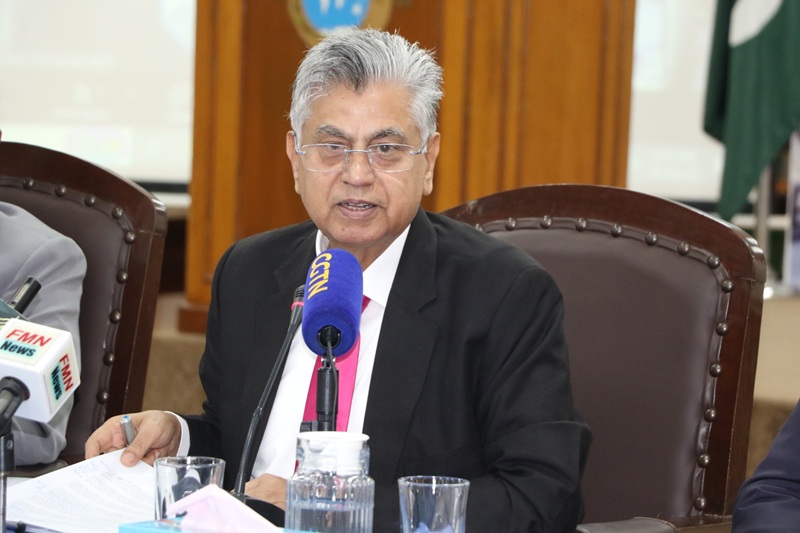
Let me thank the China Pakistan Study Center at ISSI and China Media Group, the largest global media network for hosting this important session about the Global Governance Initiative, launched just at the very first day of September start in the city of Tianjin by President Xi Jinping.
Ladies and gentlemen,
As the representatives of the most nations started gathering in New York to celebrate the 80th anniversary of the UN, on September 9, this month, the apartheid and genocidal state of Israel attacked the peace negotiators gathered in Doha, Qatar, violated the national sovereignity of Qatar and tried to demolish the very foundations of the United Nations. To me the 80th anniversary of the UN sounded more like the swan song of the very institution while the announcement of rollout of the Global Governance Initiative by President Xi Jinping on September 1, in Tianjin, China, sounded like a Lark Song.
The lark song or the blowing of the bugle played in full came on the heels of a great military parade two days later to commemorate the 80th anniversary of victory over fascism. As much as the paragons of the past tried to assure us about the importance of the rule based order, everybody, specially the people of the global south in the hall of the UN building saw it as the dying deed of the order of the misrule.
How could you explain it otherwise when convicted war criminal convicted by International court, the architect of modern day Auschwitz, the butcher of 20 thousand Palestinian children, the mass murderer of over 65 thousand Gazan civilians, the genocidal thug, Netanyahu lectured empty chairs of the UN body while Mehmood Abbas, the representative of the people of Palestine was even not given a visa to come to that building, to attend the last rites, the very funeral of the UN body that promised an independent Palestinian state for the Palestinian Arabs just two years after its creation in 1947.
We must not forget the context and the background of the GGI as we all have seen the rule of big powers and creation of the Brahmans’ Club of the majority of the UN Security Council members, justifying wars, illegal annexations and mass murder sanctified by the sticks of the veto they have been wielding for most of the history of the waning body.
Call it divine retribution or whatever you will, it is very interesting that the announcement of the GGI came from the country, that was denied membership till 1971. Although the concept of the GGI is less than a month old, this thought has been in the making of many decades. Every failure of the UN, from Kashmir to Palestine has acted as the catalyst for birth of the GGI.
The Global Governance Initiative, announced in Tianjin on 1 September 2025, reaffirms the original values of the United Nations and brings development, security, and civilisation under one practical roof. Its five core ideas are simple to say may be hard to execute. We will treat them as disciplines with clear milestones in Pakistan’s plans.
Excellencies, distinguished scholars, colleagues, and friends,
Pakistan comes to this debate with lived experience. When the system works, a flood alert arrives in time, a vaccine is affordable, a small exporter reaches a market, and facts travel faster than fear. When the system fails, the weakest pay first and most.
Our own history makes the case for better governance. After the 2005 earthquake, coordinated relief, open reporting, and community leadership turned despair into rebuilding in Azad Jammu and Kashmir and Khyber Pakhtunkhwa. After the floods of 2010 and 2022, we learned again that climate does not stop at borders and that early warning, stronger local works, and fast finance save lives and livelihoods. During the pandemic, multilateral platforms kept supply lines open for vaccines and essential goods. None of these moments were perfect. All of them showed that fair rules and honest delivery change real lives.
The Global Governance Initiative gives us five guides. Let me link them to Pakistan’s priorities in plain terms.
Sovereign equality means voice with weight, not only a chair and a nameplate. Pakistan supports reform that brings more seats and more say for Asia, Africa, Latin America, and small island states. Representation should shape agendas, standards, and finance so that decisions reflect the many, not the few.
International rule of law is the anchor. Durable peace rests on dialogue, justice, and development. In our region the issue of Jammu and Kashmir is a matter of rights and legality. Since August 2019 our view has been anchored in law and rights. Since February 2021 both sides have observed a ceasefire along the Line of Control, till it was rudely interrupted in the wee hours of May, 7 under a flimsy pretext violating international law, violating our sovereignty, killing our innocent civilians and destroying our public places including schools and places of worship. Nothing was done by the organisation created 80 years ago to maintain international law and prevent wars.
Ladies and gentlemen,
Quiet borders reduce risk and free resources for growth and climate resilience. We will speak for rights, press for dialogue, and avoid steps that close the door to de-escalation.
Real multilateralism means we share burdens and measure results. Pakistan has long contributed to United Nations peacekeeping. We have hosted millions of Afghan refugees for decades, often during our own economic stress. These are reminders that cooperation is a necessity, not a luxury.
A people centred approach turns policy into dignity. People do not live in communiqués. They live in prices, jobs, hospitals, classrooms, and flood plains. Our social protection and digital payment rails aim to make help quick and fair. A farmer should receive a subsidy on time. A student should pay fees easily. A small enterprise should sell across the country without friction.
Real results are the hardest test. Warm words must become written, dated outcomes. That calls for clear milestones, finance that arrives on time, and tracking that anyone can see. When evidence shows a better path, we change course. That is what public trust requires.
Guided by these ideas, Pakistan proposes three practical tracks for joint work.
First, climate and resilience. We stand on the front lines. We will seek loss and damage finance that is real, timely, and easy to access. At home we will invest in adaptation that saves lives and livelihoods. Here is a simple yardstick. Let us cut average early warning lead times to villages by thirty percent over two monsoon cycles and publish the results. We welcome partnerships that join satellites and sensors with local stewardship and that treat communities as co designers, not as passive recipients.
Second, connectivity and productive capacity. Pakistan and China have moved into a second phase that puts the focus on jobs, exports, and skills. Special Economic Zones should pass four tests. Do they lower logistical costs. Do they green the energy mix. Do they transfer skills. Do they help small firms join larger value chains. Here is a clear goal. Let us reduce Karachi to Lahore freight dwell times by a quarter within two years through rules and logistics upgrades that everyone can see. Corridors should carry energy, fibre, knowledge, and opportunity to communities, not only freight to ports.
Third, technology and trust. Artificial intelligence and data can widen access or widen inequality. The difference is rules. We will back interoperable standards, privacy protection, and responsible use. A concrete step is to publish annual, independent audits of public sector algorithmic systems for bias and safety. We invite cooperation on skills, safety research, public interest compute for education and health, and digital public infrastructure that is open, secure, and rights respecting.
Economic governance is the hinge that lets these tracks move. Fixing the power sector must show up in lower losses, fairer tariffs, and better service. Predictable rules should attract investment for value addition, not for quick arbitrage. Trade growth depends on standards and compliance as much as on tariffs. When Made in Pakistan means reliable quality and on time delivery, markets open and jobs follow.
Information integrity is a core task and close to my professional life. Facts are public goods. Free and responsible media, the safety of journalists, and credible public communication help societies manage disagreement without disorder. In an age of synthetic content, monetized disinformation and engineered falsehoods, let us test a rapid verification protocol for disaster content across public broadcasters and platforms so that citizens receive timely, trusted information when it matters most.
Our partnership with China sits inside this wider approach. It is strategic and it is practical. Infrastructure, energy, agriculture, and human resource development are established pillars. We should now add green transition, digital connectivity, public health, and research networks that give our young people more paths to create and to compete. Multipolarity should build bridges, not silos. Bridges lower costs for citizens and raise the quality of services they receive.
Colleagues, let us test our sincerity with simple steps. Before we meet again, let us publish one shared page of milestones and dates that any citizen can read and measure. Set targets that matter to people. Align finance with those targets. Track progress in the open. Correct course when evidence demands it.
Keep multilateral forums at the centre. Keep sovereign equality as the guarantee. Keep multilateralism as the method. Keep people at the heart. Keep results as the test. This is the spirit of the Global Governance Initiative and it is the discipline that citizens expect from all of us who speak in their name.
I offer these thoughts with humility. Pakistan has much to improve and much to learn. We will listen carefully, share candidly, and work steadily with friends who are willing to partner in good faith. Where we fall short, we will say so and try again. Where we succeed, we will give credit widely.
I thank the China Pakistan Study Centre at ISSI and China Media Group for creating this space for practical dialogue. May our work move from debate to design, from principles to practice, and from promises to proof, with patience and respect for each other.
Thank you.