





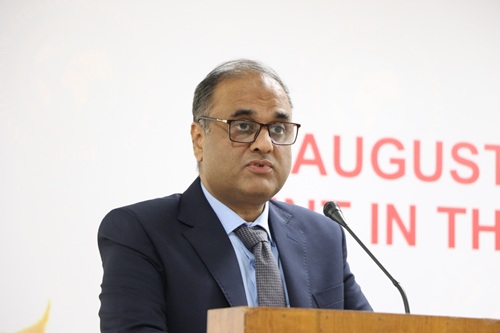
Statement by Additional Secretary (Asia Pacific) Ambassador Imran Ahmed Siddiqui at Institute of Strategic Studies, Islamabad on 05 August 2025
Ambassador Khalid Mahmood, Chairman, Board of Governors, Institute of Strategic Studies, Islamabad
Ambassador Sohail Mahmood, Director General, Institute of Strategic Studies, Islamabad,
Distinguished Guests, Ladies and Gentlemen,
We meet today on the sixth anniversary of India’s unilateral and unlawful action of 5 August 2019, when India sought to extinguish the legal and political identity of Jammu and Kashmir through legal chicanery and coercive military occupation.
To regard this act in isolation would be to ignore the deeper historical continuum in which it is embedded. For 78 years, the people of Jammu and Kashmir have awaited the fulfillment of a pledge made before the world. The United Nations Security Council, through a series of binding resolutions, declared that “the final disposition of the State of Jammu and Kashmir shall be made in accordance with the will of the people,” expressed freely through a UN-supervised plebiscite. That promise remains unfulfilled because India – a party to the commitment – chose to abandon legality in favour of suppression.
In the years since, India has employed every illegal instrument to render its occupation permanent. What was a disputed territory has been subjected to a campaign of demographic engineering, legal distortion, and systematic marginalization. The issuance of domicile certificates to outsiders, the redrawing of electoral boundaries, the alteration of land ownership laws, and the arbitrary inclusion of non-residents in electoral rolls are not administrative measures, they are components of a long-term strategy to transform the native population into a political minority on their own soil.
These measures constitute a violation humanitarian law including the Fourth Geneva Convention which prohibits demographic manipulation in occupied territories. No act of legislation, however artfully drafted, can confer legitimacy upon an occupation sustained through force and fear.
Ladies and Gentlemen,
Self-determination is a foundational principle of international law, enshrined in Article 1 of the UN Charter and reaffirmed in the International Covenant on Civil and Political Rights. It is the legal expression of political dignity, denial of which creates a structural instability.
Today, in Indian Illegally Occupied Jammu and Kashmir (IIOJK, political leaders who commanded mass support have been imprisoned for decades. Syed Ali Shah Geelani died under house arrest. Musarrat Alam Bhatt remains in perpetual confinement. Shabbir Shah has spent over thirty-five years in detention. Yaseen Malik, sentenced to life in 2022, now faces the death penalty. This reflects a broader policy of eliminating legitimate political representation.
The Indian state has proceeded to outlaw political parties, shutter the All Parties Hurriyat Conference office, ban bar association elections, and silence independent media. The Srinagar Press Club stands closed. Civil society, once a fragile but vital space for dialogue, has been effectively extinguished.
The legal infrastructure that sustains this repression is rooted in impunity. Laws such as the Public Safety Act (PSA), the Armed Forces Special Powers Act (AFSPA), and the Unlawful Activities (Prevention) Act (UAPA) grant near-absolute powers to security forces. Arrest without warrant. Detention without trial. Destruction of property without consequence. These are blunt instruments of collective punishment.
In recent months, property confiscation has emerged as yet another tool of repression. Families are uprooted. Homes demolished. Livelihoods annihilated. This is not governance. It is coercion dressed in legal garb.
These realities are not hidden. They are documented and increasingly condemned. The United Nations Office of the High Commissioner for Human Rights, the Independent Permanent Human Rights Commission of the OIC, and a host of Special Rapporteurs have spoken clearly. The former UN Rapporteur on Minority Affairs, warned against India’s effort to present a “veneer of normalcy” amidst widespread violations. His call was unambiguous: the world must “decry and condemn,” not remain silent.
Ladies and Gentlemen,
The dangers posed by India’s conduct are not limited to its treatment of Kashmir. They extend to the broader fabric of regional peace and legal order. A particularly sobering example is India’s recent moves to undermine the Indus Waters Treaty, a landmark agreement brokered by the World Bank and sustained for over six decades as a rare pillar of stability between adversaries.
India’s posture seeking to hold the treaty in abeyance and to unilaterally alter its operational character must be seen for its instrumentalization of water as a tool of coercion. It reflects a broader pattern in which legally binding commitments are discarded when inconvenient, and multilateral understandings are replaced by unilateral diktat.
The same mindset that disregards the plebiscite in Kashmir now challenges a treaty governing the lifelines of millions. Such behavior poses a direct threat to the principle that treaties must be honoured and reveals the growing asymmetry between India’s obligations and its ambitions.
Ladies and Gentlemen,
Peace in South Asia cannot be sustained on broken promises and buried rights. India’s occupation is not merely illegal, it is unsustainable, unjust, and ultimately self-defeating.
Pakistan remains unwavering in its support for the Kashmiri people’s right to self-determination. That support, political, moral, and diplomatic, is not subject to expediency. It is rooted in the firm conviction that no lasting peace can be achieved at the expense of justice.
Let this anniversary be not only a moment of remembrance but also a renewed call for resolve, that the law must prevail over force, that promises made must be kept, and that the people of Jammu and Kashmir must one day be free to decide their own destiny.
I thank you.