




Welcome Remarks by Director General ISSI, Ambassador Sohail Mahmood, at Distinguished Lecture by H.E. Radoslaw Sikorski, Deputy Prime Minister and Foreign Minister of the Republic of Poland
ISSI, 23 October 2025
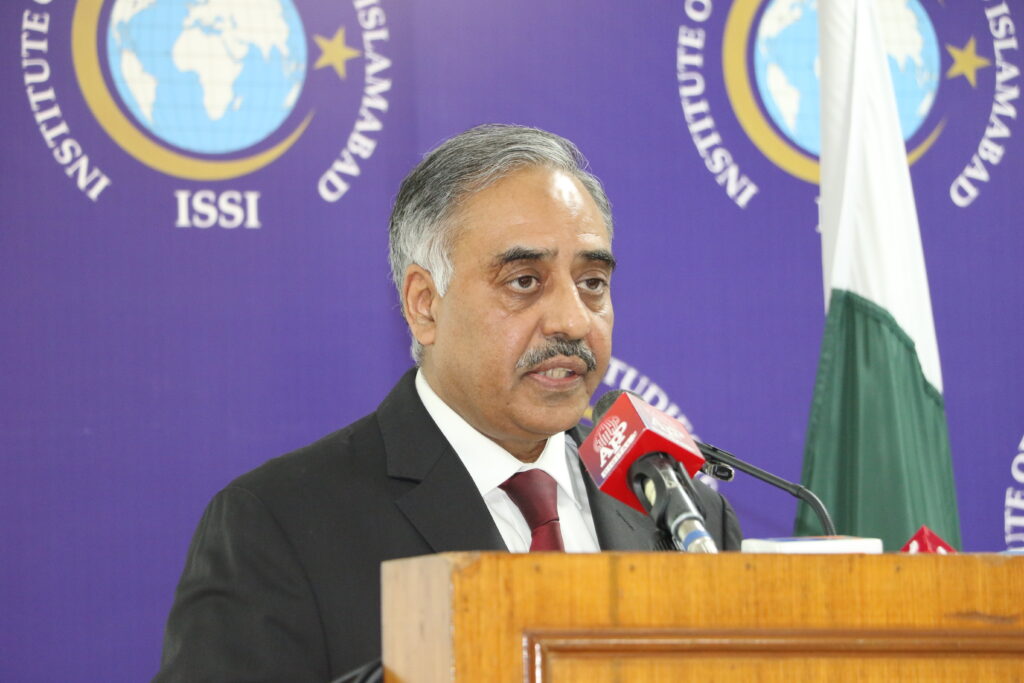
It is a distinct honour to welcome His Excellency Radosław Sikorski, Deputy Prime Minister and Minister of Foreign Affairs of the Republic of Poland, to the Institute of Strategic Studies for this Distinguished Lecture. We are profoundly grateful, Excellency, for your gracious acceptance of our invitation. We look forward to benefiting from your wisdom, given your deep knowledge of the region and your achievements as a thought leader and an astute diplomat.
We are also delighted to co-host this event with the Polish Institute of International Affairs (PISM). This is the first joint activity that we are organising in implementation of the MoU that Director Karpowicz and I signed in the presence of the two Deputy Prime Ministers and Foreign Ministers earlier today. We hope this collaborative partnership will grow substantially in the time to come and help bring our research and think-tank communities closer to our mutual benefit.
The theme of this Distinguished Lecture, “Poland’s Success Story: A Message for the Rising Countries”, is of seminal importance. Poland is widely regarded as one of the most successful European transformation stories of the post-Cold War era, a country that has navigated systemic change, economic restructuring, institutional reform, and global integration with remarkable discipline and strategic foresight. Poland’s trajectory, from transition to consolidation, and from resilience to strategic relevance, is admired by many across the developing world, including Pakistan.
Poland’s success is neither accidental, nor coincidental. It is the outcome of resolute resolve — rooted in a strong sense of national purpose, institutional pragmatism, human capital development, and an approach to statecraft that harmonised tradition with innovation. Poland’s journey illustrates how a medium-sized state, situated at the intersection of great-power competition, can rise through strategic clarity, economic dynamism, and diplomatic agility.
Many countries in the world today are seeking to successfully navigate a treacherous global environment while pursuing the goals of sustainable development, institutional revitalization, and wider international partnerships. Poland’s experience offers important insights, not just as a case study of successful transition, but also as an example of confidence-building in a rapidly transforming world.
We also welcome you, Excellency, at a time when Pakistan and Poland are working to chart new horizons in bilateral and multilateral engagement including in the EU. The two countries have enjoyed long-standing friendly ties — marked by mutual respect and close collaboration across multiple domains. The Pakistan Air Force, counted among the best in the world today, would never forget the invaluable contribution that Polish pilots made in its formative phase. Air Commodore Turcowiz would always be among our own heroes.
More recently, Pakistan and Poland have focused on imparting greater depth and economic content to the bilateral relationship. There is real potential in trade, investment, mining and energy, green technologies, higher education, innovation ecosystems, institutional linkages, and people-to-people exchanges. This high-level visit to Islamabad is sure to lend further momentum to this process.
Excellency,
As we all recognize, the world today is in deep flux, marked by the intertwined phenomena of turbulence and transformation. The old and traditional security threats and challenges are accentuating, and the new and non-traditional threats and challenges are proliferating. Balancing security imperatives with development imperatives remains one of the stiffest challenges of statecraft everywhere. Meanwhile, as major-power contestation intensifies, the global order keeps moving in a multi-polar direction.
Within this complex milieu, Pakistan has worked with dexterity to acquire new strategic salience, leveraging its pivotal geography, military capability, and nimble diplomacy. Some have ascribed this to a “proactive equilibrium” strategy that balances economic pragmatism with strategic partnerships. So we see a diversified foreign policy and a growing pivot towards geo-economics. From further fortifying the all-weather strategic cooperative partnership with China to deepening the long-standing partnership with the U.S., and from reinforcing constructive engagement with all major powers including Russia, Japan, EU, and Africa, to strengthening alliances and partnerships in the Middle East, Pakistan is on an entirely different regional and global trajectory. It remains a strong advocate of cooperative multilateralism and a formidable presence in the UN Security Council. In myriads of ways, it is making valuable contributions both as a Middle Power and an influential voice of the ‘Global South.’
As Pakistan recalibrates its own external engagement in a rapidly shifting geopolitical landscape, we see Poland as a partner with whom we can share not only dialogue but also experiences. Experience of economic transformation, of institutional reform, and of strategic positioning in a multi-polarising world. In that vein, today’s Distinguished Lecture promises to be not only a reflection on history but also a forward-looking conversation about what rising states can learn from Poland’s journey and exemplary experience.
As I conclude, I wish once again to thank His Excellency Deputy Prime Minister Sikorski for honouring us with his presence. We look forward to a rich discourse.
Thank you.