




“Pakistan has made its choice. We have chosen dialogue over confrontation. We have chosen cooperation over coercion. We have chosen peace over war.”
— Prime Minister Muhammad Shehbaz Sharif, Address to the 81st Session of the United Nations General Assembly
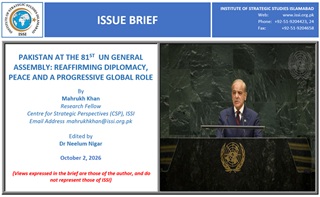
Pakistan’s Prime Minister Shehbaz Sharif’s address to the 81st Session of the United Nations General Assembly (UNGA) presents Pakistan’s foreign-policy outlook through the interconnected themes of peace, dialogue, conflict prevention, multilateralism, development, climate justice and reform of the international system. The speech seeks to position Pakistan not merely as a state affected by regional and global conflicts, but increasingly as a country willing to contribute to their peaceful resolution.
The overarching message is captured in the Prime Minister’s assertion that
“War is a choice, but peace is also a far better choice,” followed by the declaration:
“Pakistan has made its choice. We have chosen dialogue over confrontation. We have chosen cooperation over coercion. We have chosen peace over war.”
This emphasis is particularly significant when considered alongside Pakistan’s recent diplomatic activity. During 2025–26, Islamabad has sought to employ dialogue and facilitation in several difficult regional situations, including the Pakistan-India crisis, the U.S.-Iran conflict, the Gaza question, and wider Middle Eastern tensions. Pakistan’s sponsorship of UN Security Council Resolution 2788 on peaceful settlement of disputes during its July 2025 Council presidency further provides an institutional dimension to this approach.