







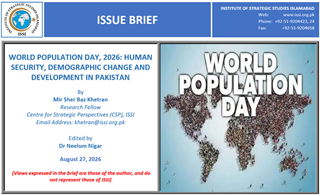
Observed annually on 11 July, World Population Day provides an opportunity to examine how demographic change affects people’s lives and a country’s capacity to deliver development. Established by the United Nations Development Programme (UNDP) in 1989, the observance was inspired by the world population reaching five billion in 1987.[1] For Pakistan, the occasion is particularly relevant because population growth is increasingly shaping the country’s economic choices, social pressures, environmental risks and national resilience.
According to Pakistan’s Bureau of Statistics (PBS), Pakistan’s population reached 241.49 million in the 2023 Population and Housing Census, with an average annual growth rate of 2.55 per cent between 2017 and 2023.[2] United Nations Population Fund (UNFPA) projections indicate that Pakistan’s population could reach approximately 403 million by 2050 if current demographic trends persist.[3] These figures matter because every additional cohort requires schools, healthcare, jobs, housing, water, energy and transport. The central policy question is therefore not whether a large population is inherently a problem, but whether Pakistan’s economy and public institutions can expand opportunities and services fast enough to keep pace with demographic change.