






Remarks by Director General ISSI Ambassador Sohail Mahmood at Seminar “Civilian Protection in Multidomain Conflicts: Legal and Humanitarian Perspectives on ‘Operation Sindoor’”, ISSI, 10 September 2025
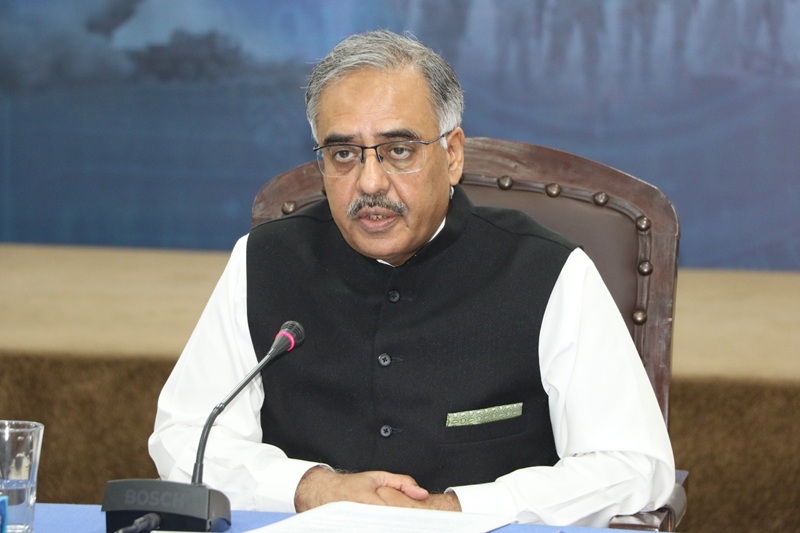
Let me begin by welcoming everyone to this Seminar on the protection of civilians in armed conflict, with special reference to India’s ‘Operation Sindoor’ in the recent India-Pakistan conflict of May 2025. The ISSI is pleased to organize this Seminar in collaboration with Mishal Pakistan, and I acknowledge the valuable contribution of its CEO Amir Jahangir in underscoring this vital concern.
We have a group of eminent academics, legal experts, and civil society leaders to shed light on the myriad dimensions of this important subject. They will share insightful perspectives on the normative and legal aspects of the issue, the role of international legal institutions, and the part diplomacy can play in ensuring accountability. Besides ‘Operation Sindoor’, speakers would also highlight how the Kashmiris in IIOJK continue to be subjected to indiscriminate violence and a relentless assault on their human rights by the occupying power.
It is a privilege to have former Minister for Law, Justice and Parliamentary Affairs, Mr. Ahmer Bilal Soofi, as the Guest of Honour for the concluding session. He has been front and center in the protection and promotion of Pakistan’s interests in the domain of international law. We would be enlightened by his incisive views on this matter.
Distinguished participants,
As we are all aware the Pahalgam attack of 22 April 2025 was used as a pretext by India to launch completely unjustified and reckless military aggression against Pakistan. Without holding any worthwhile investigation or sharing even a shred of evidence, India accused Pakistan of complicity in the Pahalgam attack and expected the world to endorse both its false narrative and its bellicose intentions. Obviously, the world community did not oblige. India also rejected Pakistan’s offer for a transparent, credible and neutral international investigation into the incident. Many in the international community viewed this offer as reasonable and a way to avoid conflict that could seriously endanger international peace and security.
Under its ‘Operation Sindoor’, India struck civilian areas in Pakistan and Azad Jammu & Kashmir — including residential neighborhoods, Mosques, and essential services. In these indiscriminate strikes, 40 civilians lost their lives including women and children. Besides being a breach of the time-honored principles of inter-state relations, India’s belligerent action represented a clear violation of international humanitarian law and the UN Security Council resolutions on the protection of civilians in armed conflict.
Article 51 of the Additional Protocol of the Geneva Conventions of 1949 deals with the protection of the civilian population and explicitly prohibits indiscriminate attacks. Article 51(5)(b) of the Additional Protocol describes ‘indiscriminate attack’ inter alia as: “an attack which may be expected to cause incidental loss of civilian life, injury to civilians, damage to civilian objects, or a combination thereof, which would be excessive in relation to the concrete and direct military advantage anticipated.” Furthermore, Article 51(6) clearly stipulates that, “Attacks against the civilian population or civilians by way of reprisals are prohibited.” As we all know, this Article 51 remains one of the core legal foundations for the protection of civilians in armed conflict under International Humanitarian Law (IHL).
For the last 25 years, the UN Security Council has also maintained a sharp focus on the protection of civilians in armed conflict. The Council’s foundational resolution S/RES/1265 (1999) strongly condemns the deliberate targeting of civilians in situations of armed conflict as well as attacks on objects protected under international law and calls on all parties to put an end to such practices. The resolution also emphasizes the importance of preventing conflicts which could endanger international peace and security and stresses implementing appropriate preventive measures to resolve conflicts, including the use of the United Nations and other dispute settlement mechanisms.
Pakistan’s response to India’s unprovoked aggression was distinctly different. Acting within its rights to defend its sovereignty and territorial integrity, Pakistan restricted its operations to specific military targets. It focused on Indian command centres and combat assets, while avoiding civilian harm. In doing so, Pakistan aimed to uphold its right to self defence, remaining within the parameters of combat rules and humanitarian norms. It demonstrated both military strength and moral restraint.
Within a wider context, Indian action of May 2025 cannot be seen as an isolated violation of international humanitarian law. It must be viewed as a continuum and a part of a trajectory of serial abuses of human rights — extending from its unlawful and rogue conduct in IIOJK to the ‘Operation Sindoor’ conducted on the basis of fabricated charges. The extrajudicial killings, torture, lockdowns, communication blackouts, and widespread suppression of dissent in IIOJK served as the ominous backdrop for India’s treacherous assault of May 2025. Together, they represent not episodic misconduct, but a pattern of unremitting hostility and aggressive behavior on the part of India. This linkage underscores how vital it is to see violations in one domain leading to excesses in another – rather than treating each catastrophe as an isolated occurrence.
Distinguished participants,
Civilian protection cannot be treated as secondary in warfare; it is the ultimate moral and legal boundary. Allowing impunity for civilian losses in ‘Operation Sindoor’ risks setting a precedent that undermines international humanitarian law and the very institutions meant to uphold it. It is imperative to consider essential diplomatic and legal recourse to ensure accountability.
We hope our distinguished speakers will help evaluate ‘Operation Sindoor’ as more than just a regional conflict; rather, as a litmus test for the resilience of international humanitarian law, the effectiveness of global governance frameworks, and the imperative need for states to fulfil their obligations towards civilian protection amidst combat operations.
Thank you.