








Foreword
Water has been central to the story of human civilization. From the earliest settlements along the Nile, Tigris-Euphrates, Yangtze, Indus and other major river systems, access to water enabled communities to develop agriculture, sustain livelihoods, build cities, and establish enduring civilizations. The availability, control and management of water have often influenced the development, prosperity and at times, decline of societies. Even today, water remains indispensable for human life, food security, economic development, energy production and environmental sustainability.
Given its vital importance, water has also been a source of tension and conflict among communities and states. Competition over access to water, its allocation and distribution, and the rights of upstream and downstream uses has often complicated inter-state relations in many parts of the world. From the ancient city-states of Mesopotamia to the modern nation states including Ethiopia and Egypt, Turkey, Syria and Iraq, China and Laos, and Pakistan and India, disagreements over transboundary waters have often intertwined with wider political, economic, and strategic interests. These states have sought to manage such differences through water-sharing agreements, institutional mechanisms and treaties, mostly with the assistance of third parties.
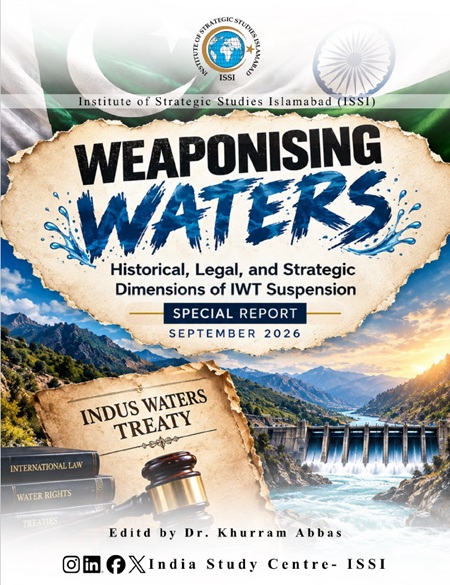
In South Asia, the 1960 Indus Waters Treaty (IWT) between India and Pakistan provides an important example of such cooperation. After a decade-long negotiations, facilitated by the World Bank, the two countries reached the consensus for allocation and the use of waters of the Indus river system, together with institutional and dispute-resolution mechanisms. Despite wars and periods of political and diplomatic tensions, the Treaty performed well in providing a framework for managing differences over shared waters.
However, India’s unilateral decision to put the Treaty ‘in abeyance’ following the Pahalgam attack in May 2025 has triggered a new and uncertain phase and further deteriorated ties between the two countries. Pakistan has rejected New Delhi’s decision maintaining that the Treaty does not provide for its unilateral suspension and also termed it as an act of war. In view of Pakistan’s dependence on the Indus Basin and the wider implications for its water and food security and transboundary water governance, the recent developments warrant a careful examination.