








Introduction
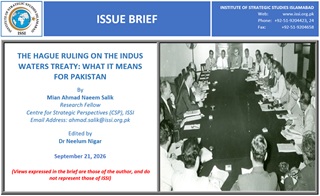
The Indus Waters Treaty (IWT) has entered perhaps its most uncertain phase since it was signed in 1960. India’s decision in April 2025 to place the Treaty in “abeyance” marked a sharp departure from more than six decades of practice. On August 31, 2026, the Court of Arbitration constituted under the IWT issued its most consequential ruling in the current proceedings. It held unanimously that the Treaty remains fully in force and that India cannot place it in “abeyance” through a unilateral decision. The Court also issued limited interim measures concerning the Ratle Hydroelectric Plant while the parallel Neutral Expert process continues.[1]
This clarification matters for Pakistan as the Indus system underpins irrigated agriculture, food security, rural livelihoods and a large part of the wider economy. Agriculture contributes around 23.4 per cent of GDP. The ruling therefore strengthens Pakistan’s legal position, but it should not be read as a complete answer to water insecurity.[2]